
Sunday morning. May 23rd 2008. The Port of Holyhead. Cars carrying all manners of red drapery are thronged with the tired, mildly inebriated and thoroughly sozzled. Drunk or sober, all are happy. And why wouldn’t they be?
It’s been just a few hours since Munster won the Heineken European Cup for the second time in three seasons. In a tense decider, they saw off the mighty Toulouse, the only team to have played more ERC games than the southern province.
The small cafeteria at the port is doing a lively trade, as tales of another great day are shared over steaming cups of tea and coffee.
A few livelier lads in the queue have clambered out of their cars to throw a rugby ball about. It kills the time well before boarding the Cypriot-registered vessel.
After a few hours in the car, and the prospect of sleeping on a ferry lounge floor awaiting them, loosening the limbs is a decision Solomon himself would have been proud of. Considering what’s been consumed all day, the ball handling isn’t too bad either.
A few bleary eyed chaps join in as the oval zips one way and then the other, while the occupant of the car immediately ahead of me has cranked up the volume of his CD player.
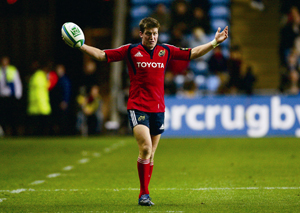
‘The Fields of Athenry’ fills the car park skies. ‘The Rose of Tralee’ soon follows. ‘Stand Up and Fight’ rallies the vocal chords of the masses, before a giggle is had when ‘Flannery’ – Mario Rosentock’s take on The Zutons’ ‘Valerie’ gets its turn on a Toyota-hosting turntable.
It may well be a long night, but it’s been a mightily enjoyable conclusion to a mightily enjoyable day. The men of Munster have given us so many wonderful adventures over the past decade that it’s proving difficult to keep track. Not that I’m complaining!
Fast forward seven months. As I made my way into Thomond Park ahead of the stunning Munster/Clermont Auvergne battle on Saturday week last, Declan Kidney was strolling in the opposite direction.
Nobody was making an obvious fuss about him. Nobody was muttering “look, there’s Deccie” as he walked away from the Shannon clubhouse. Nowt. Rien. Niente. He was just like any other punter heading for his seat – just the way he’d like it.
But it must still feel odd for Kidney not be to standing in the Thomond Park dressing room ahead of a big European Cup match.
After all, as the man who has masterminded two successful continental campaigns over the past three seasons, he knows what makes Munster tick better than most.
Some would say he was what made the team tick at the highest level for most of the past dozen years. He, of course, wouldn’t agree with that sentiment.
Once a team runs down that tunnel, once the referee blows that whistle, a coach can only control so many variables. The rest he must entrust to his players.
“You could get carried away with yourself but when people have been doing something well for 120 years you’re not inclined to ignore all that,” Kidney told this newspaper at the start of the 07/08 campaign.
It’s difficult to imagine the new Ireland coach getting too carried away about anything, not that that’s implied as a criticism. Tradition and temperament follow Declan Kidney wherever he lays his coaching manual.
He’s a measured man. He’s a methodical man. There’s nothing left to chance with him.
When the draw for the Cardiff final declared that Munster would wear their navy away kit, Kidney decided that the team would wear those colours in the Magners League games leading up to the clash with Toulouse.
“We go about our business in what I describe as the Munster way,” said Kidney, who was named as Philips Sports Manager of the Year recently.
“We can do it and then talk about it rather than talking about it first only to fall down.” Kidney has moved on, Tony McGahan has stepped up; the transition practically seamless as the Munster march continues into 2009.
And as results on the pitch have proven in recent years, Munster get the job done and then talk about it and, in turn, get lots of other people enthusiastically talking about it too. And look what their endeavours have led to.
Munster’s success has spurned an industry of books, DVDs, dinners, credit cards and a jersey-selling phenomenon that even the burghers of Old Trafford must be envious of.
The province’s name is now twice etched onto the base of the European Cup and they’re surely in with a decent shot of keeping an engraver busy in Edinburgh next May.
And as the latest heroics in Thomond Park demonstrated, it’ll take one hell of a team to break Munster’s grip on the trophy.
They’ll also end the year as leaders of the Magners League, proof that the depth of talent at Tony McGahan’s disposal has significantly increased. The so-called second XV’s display against the All Blacks was proof positive of that.
It’s odd that in a year when a predominantly Irish-born team was crowned champions of Europe that that particular occasion doesn’t stand alone. But that’s this team for you.
Tuesday night. November 18th 2008. Thomond Park. Munster 16 New Zealand 18. A long-standing convention of sports journalism is being broken by many a seasoned hack: they’re applauding. And why wouldn’t they?
Be one the most hardened cynic or the
biggest bandwagon bashing critic of them all, what occurred that night in Limerick transcended the mere playing of a rugby match.
In the hype-filled sphere that top grade sport increasingly occupies, this match raised the roof higher than Thomond’s glistening new stands now cover the masses. It was an extraordinary evening in almost every possible sense.
In terms of drama, in terms of emotion, in terms of gut-wrenching excitement, the lead-up to the match as well as the match itself, had no equal in the Irish sporting year.
As an occasion, it will be spoken of for decades to come both here and in New Zealand.
There was the stirring ‘Maka’, the Haka performed by Munster’s adopted Kiwis of Jeremy Manning, Rua Tipoki, Doug Howlett and Lifeimi Mafi, which set the tone for an astonishing night’s entertainment.
In the three days that followed the match, over 130,000 people downloaded the ‘Maka’ on the YouTube website. The Munster legend also grows online nowadays.
The whites of all four men’s eyes glistened (Tipoki’s tongue elongated too) as they laid down the traditional Maori challenge to their countrymen. It’s a moment the quartet could scarcely have envisaged when signing the dotted line with Munster.
Listening to Tipoki after the match, his eyes dampened by the emotion of the occasion, one sensed that intangible quality which makes this group different to any other contemporary rugby team. And I don’t just mean Leinster, by the way.
“I was just so proud to be a Munster man, even before today,” said Tipoki, crutches resting by his side. “I can feel myself getting a bit emotional now.”
Added the former New Zealand Maori skipper: “Obviously we had a lot of players who weren’t available tonight but we said it in the dressing room before we went out, we wouldn’t trade places with anyone who was in those shirts.
“Going out there we were going to be soldiers for each other, and no matter what, we were going to go to the wall for each other.
“I’m not disappointed [with the result], because of the way the boys played. We fronted up and that’s the way it was supposed to be.”
In truth, they did so much more than merely front up that night. Players such as Timmy Ryan and James Coughlan, players who’ve been on the fringe of the senior squad, burned their names into the souls of Munster fans.
They reminded you that the red jersey belongs to no player. Not ever. And when that shirt is pulled across shoulder blades, every player wearing it honours their families, their clubs, their schools and all that have worn the colours before them.
All things going well, there’ll be a Waterford successor to Ben Cronin in Munster ranks before too long. The local game will receive a tremendous fillip when that happens – and it is very much a case of ‘when’ as opposed to ‘if’ in this instance.
While Waterpark are once again labouring in the AIL this season, the work that’s
been done at underage level down Ballinakill way in recent years has been nothing short of outstanding.
Murray Kinsella, a product of the Waterpark system, has tasted training action with the senior Munster squad and regularly rubs shoulders with Paul Warwick in the colours of UL Bohemians.
As a member of the province’s academy, the Waterford-born centre sampled the preparatory delights of the Polish High Performance Centre in Spala back in August.
In that week alone, Murray enjoyed 18 training sessions plus 12 visits to the centre’s cryotherapy chambers, known for providing regenerative powers to top class athletes.
With hard work and that touch of luck that players sometimes need to make a
breakthrough, Murray Kinsella will
continue to work hard on his trade before that opportunity arises. And I’ve no doubt that it will.
The challenge facing Munster into 2009 is the same challenge that the players faced last year, the year before that and the year before that, etc.
The desire to be the best, to run faster, to kick better, to tackle harder, to never, ever submit in the face of even the sternest opposition remain the core goals. Compellingly, they continue to honour all of those ideals.
And, more often than not, when the time demands it of Munster players, they deliver – and then some, the Clermont effort the latest example of many that can be cited.
“That was probably the greatest
performance against a superior force since the defenders of Rorke’s Drift against the Impis of Ketchwayo,” reflected George Hook as only George Hook can following Munster’s heart-stopping victory.
And one predicts that Munster, a team that continues to defy logic will keep supporters talking, singing, driving and flying all over Europe for many years to come. Long may they reign.
