
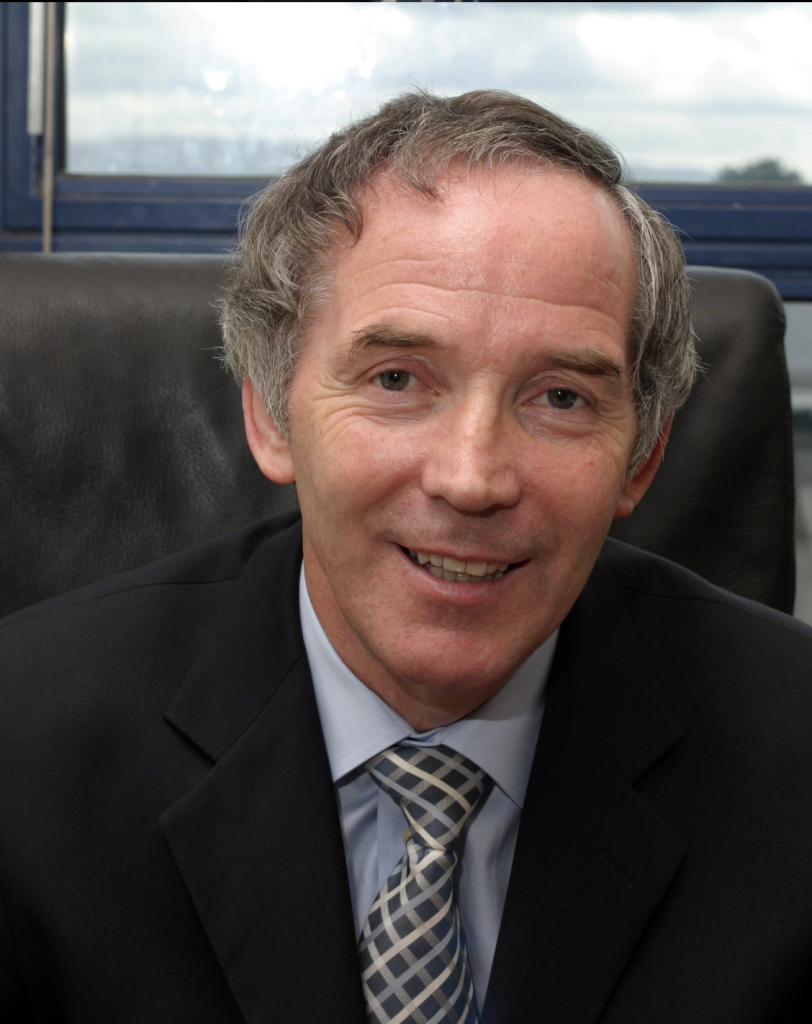
John Lonergan might not be the person that comes to mind when you picture a prison Governor, largely due to his friendly exterior.
But that’s exactly what he was, serving as Governor of Mountjoy Prison for 22 years in total, and Governor of the maximum-security Portlaoise Prison for four years.
In a wide-ranging exclusive interview with The Munster Express, Mr. Lonergan noted that there are 12 prisons in Ireland (there were three when he started working in the prison service over 40 years ago) and yet “isn’t it amazing that we haven’t come any closer to resolving overcrowding”, he said.
He also noted there aren’t any ‘open prisons’ for women and said overcrowding is “an absolute disaster in terms of privacy, mental health, drug abuse, sexual abuse, violence and bullying”.
John Lonergan is originally from Bansha, Co. Tipperary, and has given a total of 42 years to the Irish Prison Service altogether, from his work across a wide variety of jails in Ireland.
Although he retired in June 2010, he has retained his passion for wanting to improve the public perception of prisoners.
In this wide-ranging exclusive interview with The Munster Express, John talks about his time in Mountjoy, outlines how overcrowding in the prison system has been a problem almost since he began his career, and tells us that Portlaoise Prison was actually “very quiet and very relaxed”.
John began his career in 1968 when he was assigned to Limerick Prison. He didn’t particularly have ambitions to become a prison officer, but once he started, it was clearly something that he knew was for him. It was a lot different for him starting off compared to nowadays, as there were only 660 people in custody across a total of just three prisons in Ireland – Limerick, Mountjoy and Portlaoise, which included around 400 adults and 260 juveniles. This can be compared to an estimated figure of 5,600 currently spread across 12 prisons in Ireland at the moment – without counting juveniles, who are detained separately at Oberstown in Dublin.
“I started off in Limerick, and then after three years I was transferred to Shanganagh. That was an open prison at the time in Dublin and it’s no longer in existence now, but it was an open centre for boys between the ages of 16 and 21,” John said. “Open [prison] meant that there were no walls or security as such. That was a very different experience, but a very rewarding experience because you got to know the young lads and you worked with them, played sports with them and all that sort of stuff.”
“I loved Shanganagh because it was open, relaxed, I was young at the time and it was all about participation, the complete opposite to what the regime in a prison was, which was very much like, you didn’t involve yourself or even speak to prisoners. Shanganagh was all about participation, and I really enjoyed that, playing football or playing volleyball with them, it was very interesting,” he added.
After leaving Shanganagh, John spent a couple of years at Loughan House prison in Cavan, before being assigned to Mountjoy for the first time in 1983. He took over as Governor a year later, and then went to Portlaoise Prison in 1988. He later returned to Mountjoy in 1992, where he remained for the next 18 years up until his retirement in 2010. He spoke about some of the positives and negatives of his time at Mountjoy, which included playing a role in the opening of the Dóchas Centre women’s prison in 1999, bringing in a drama project and organising school visits, while also dealing with overcrowding and the deaths of prisoners in custody.
HIS TIME AT MOUNTJOY
John said: “I suppose the biggest achievement when I was in Mountjoy would have been being involved in the design, development and delivery of the new women’s prison, the Dóchas centre. I spent a number of years in the planning of that and campaigning for it, and that was probably the ultimate in terms of an achievement to bring that to fruition.”
“We introduced an annual drama project that became a national event for 20 years because we invited the public in. In the end, we were running it seven nights a week. That was a great highlight, because it opened up prisons and allowed the public to see prisoners from a different perspective, to see them in a positive way rather than a negative way. I used to say they’re not my prisoners, they belong to you, the society. I’m only managing it on your behalf, because ultimately you, the public, have responsibility for it,” he added. “That was one way of trying to introduce them, but our school project, which ran for the best part of 15 or 20 years, where transition years and other students were able to visit the prison at lunchtime every day, four days a week, was a very rewarding thing as well.”
John also outlined his push to set up two community work projects for the prisoners, which he said again ran for around 20 years and involved the prisoners helping to build facilities such as community centres and scout halls in areas in Dublin. He highlighted that another positive of his time at Mountjoy was the improvement in psychiatric services for prisoners, which were “absolutely diabolical” at the time when he was starting out with the Prison Service. When speaking about the negatives of his time in Mountjoy, here is what he had to say:
“I suppose the negatives would have been that for most of my time in Mountjoy, we had ongoing overcrowding. But the biggest negative in terms of something that happened in my time would have been in 1997, when I think about five or six prisoners took four prison officers hostage and held them for a weekend in January 1997. That was a low point in terms of the horrendous consequences of that for the four staff involved. That was a really bad time in Mountjoy.” During John’s time as Governor, a number of people also died in custody from incidents such as stabbings, drug overdoses or suicide, with one period of time seeing five deaths in a three month period.
THE PROBLEM OF OVERCROWDING
Our conversation turns to the problem of overcrowding, which has been rearing its head almost since John started out working for the Prison Service, and continues to do so today. “It’s a disaster really. The first overcrowding was recorded in St Patrick’s Institution in 1969. And from that day onwards, we have had overcrowding at different levels, right throughout the prison system, and we have built and built and built prisons,” John said.
“There were only three prisons when I started off, I think there’s 12 at the moment. And isn’t it amazing that we haven’t come any closer to resolving overcrowding now than we had 57 years ago. And even though we have built and built and built, the answer to it is, we have to cap numbers if we are serious about it. The 2024 Annual Report of Prisons highlighted that 5,091 people were committed to prisons in 2024, 3,700 during 12 months or less. It’s an absolute lunatic policy to be sending people to prison for that length of time,” John added.
“We don’t have any open prisons for women as well. We have the highest number of 220 people packed into the Dóchas Centre, which was built for 85. And we had a new beautifully modern prison open in Limerick, which only lasted a couple of weeks before it was doubled up and tripled up, and doubling and tripling up is the most retrograde step that has ever taken place in prison. It’s an absolute disaster in terms of privacy, mental health, drug abuse, sexual abuse, violence and bullying,” he explained.
SOLUTIONS
In John’s view, two of the main solutions for this would be to cut the numbers entering our prisons, and for alternative options to imprisonment to be considered. “What you need is a comprehensive alternative to prison. It’s costing 100,000 now on average, for every prisoner…That’s a lot of money. If we spent half that money out in the communities, if we were spending more money and put more infrastructure into those deprived, disadvantaged communities, we’d be cutting down the number of young people in prison. I’m mainly saying that we should be cutting the numbers going into prison, we should be capping numbers, and we should be diverting the ones that are going into prison now doing 12 months or less, and we should be diverting them into community activities in terms of education, drug treatment, counselling and community work. There’s a whole lot of different options that are out there, but we need the infrastructure and we don’t have the infrastructure.”
He added: “You can punish people in a more positive way than just throwing them into prison. Nobody gains when you throw somebody into prison. Everybody’s a loser. With our work projects, that was a way of showing that prisoners could contribute very positively to mainstream society. Many prisoners have that capacity, and all we need is the infrastructure to enable them to do so.”
“Jim O’Callaghan is only in the job a year as Minister for Justice, but so far, I don’t see any signals that he is grasping it, because I hear him talking about providing more, more space. They have absolutely sabotaged every single prison that has been built over the last number of years in terms of open space and facilities. Adding on wings and corners and nukes to every open space in Wheatfield, Portlaoise, the Midlands, Limerick, Mountjoy, everywhere. They have turned all the prisons into nothing more than concrete jungles,” John said.
HIS TIME AT PORTLAOISE PRISON
John served as Governor of the maximum-security Portlaoise Prison from 1988 to 1992, and spoke about how different it was from Mountjoy, with one of the reasons including the presence of IRA prisoners. “It was a completely different regime to Mountjoy. They [members of the IRA] had a commanding officer which they elected to represent them. So instead of meeting individual IRA prisoners, you met the spokesperson once a week, and all individual requests went through that. You never got to know the prisoners individually as you would in Mountjoy, because you’d be meeting them regularly and talking to them…But security was the number one priority, and I suppose the basic rule in Portlaoise was thou shalt not escape.”
“And that was because that was a political thing, so security was the be all, end all and everything else didn’t escape. So… as a Governor running the prison, to compare Portlaoise at that time with Mountjoy, there was no comparison. Mountjoy was an ongoing headache. Day in, day out, unpredictable. Anything that could happen did happen. Portlaoise was very quiet and very relaxed,” he said.
REDEFINING OUR VIEW OF PRISONERS
An important part of John’s career has appeared to be a sustained effort to redefine public perception of prisoners, which he did through organising the work projects, and doing interviews with the media. “I did my fair share in trying to, I did loads of interviews and wrote stuff to highlight the complexity of it, and the difficulties and challenges, especially around social justice and equality and equal opportunity, social deprivation, the consequences of that and drug addiction,” John said. “90% were from the two lowest socioeconomic groups, and six little small areas in Dublin City were supplying 75% of the prisoners to Mountjoy, all poor areas, with poor levels of education, only 6% of the prisoners stayed in school after 16. One in four had an inpatient history in a psychiatric hospital before they came to prison. I was just trying to highlight that this is not a black and white thing.”
He concluded: “You have a captive audience, but that’s rubbish in the sense that you can’t force people to change, but you can help them to change. I suppose arguing as well and advocating to give people a second chance or a third chance, if necessary, because otherwise, you know, they were just going to continue in and out of prison.”
Funded by the Court Reporting Scheme
