
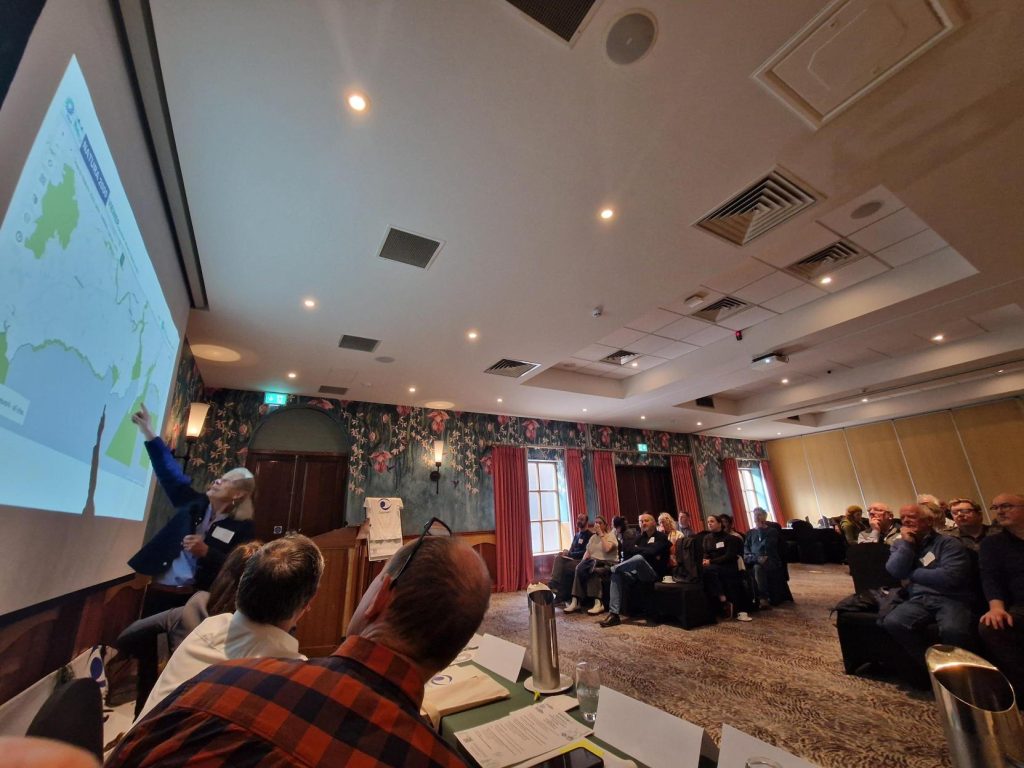
The Munster Express featured on a panel at a conference for Coastwatch on February 27 last to discuss the future of the Waterford Estuary.
The estuary has received unprecedented attention this year as stakeholders organised to revive the estuary villages, mainly through the Waterford Estuary Villages Alliance, and EirGrid announced a major windfarm in an area of the South-East coast known as Tonn Nua.
Plans for the Tonn Nua windfarm were unveiled during the Plenary meeting of Waterford Council in January. The Great Island power station on the Wexford side of the Estuary will be the landfall location for the region, as the infrastructure gets improved to handle the huge amount of power the offshore windfarm will generate.
These developments have built on longstanding concerns regarding water quality in the estuary.
Until 2023 raw sewage was being released into the water from the Wexford side. This ceased when a newly built facility eliminated a reported 1,500 wheelie bins of raw sewage from entering the estuary per day.
The Environmental Protection Agency published their flagship Water Quality in Ireland 2019-2024 report on 13 October last. The report highlighted the ongoing issue of nitrate pollution, as the area around Belview Port was shown to have an inorganic winter nitrate rate 50% above the recommended threshold, which was the worst classification available. Water near New Ross, on the River Barrow, received the same assessment.
As Sinn Féin Councillor, Jim Griffin, said at last October’s meeting for the Metropolitan district, “We know there’s something not right in the estuary, we’ve asked on numerous occasions where are we going, what’s causing the death of the shellfish?”
Coastwatch
Coastwatch held a workshop in Dooley’s Hotel on February 27 last, organised by environmental campaigner Karin Dubsky, with the assistance of Élise Merckel. The workshop was titled Past, Present & Future: Local & Traditional Knowledge, and sought to bring stakeholders together to discuss the role of local and traditional knowledge in modelling the Estuary’s future.
The 34 participants included local fishermen, one Wicklow fisherwoman, representatives from public bodies: LAWPRO, BIM, SFPA, Academics from Trinity College Dublin, South East Technological University, Mariners and Fair Seas and Coastwatch, NGO representatives, from counties Waterford, Cork, Kilkenny, Kerry, Wicklow.
The workshop began with a Maritime Heritage tour led by Michael Kennedy along with Joy Rooney from SETU, Waterford.
Professor Biswajit Basu, an Environmental Engineer from Trinity, gave the keynote address for the first panel, in which he described the complex environmental models being used by academics to understand how the physical equipment of offshore renewable energy can change the depths and mixing of water.
Professor Basu also outlined models that explain how complex ecological environments with many different species can actually be dependent one or two cornerstone species—the example he used was the anchovy fish in a Mediterranean bay, which, if removed, made the entire system unsustainable.
The first panel was chaired by Deirdre Lane, the Harbour Master of Dunmore East, and featured Brian Jacob, a Coastwatch Regional Coordinator, along with The Munster Express.
Following this a film about life in Waterford and Wexford’s coastal communities was introduced by Jack O’Donovan Trá, Communication Officer at Fair Seas. Panel two followed, featuring musician and conductor, Kevin O’Carroll, Senior Community Water Officer at LAWPRO Maggie Morrissey, fisherman Pat Moran, and Maura Brennan from Nore Vision.
Again, local knowledge was at the centre of panel two, as fisherman, Pat Moran, described the loss of salmon fishing in the estuary, and Kevn O’Carroll described witnessing firsthand during diving expeditions the decline of the Estuary’s natural eco system.
With major developments coming, it will hearten many to see that this prime natural asset is finally on the agenda for environmental groups, academics, and local stakeholders alike. Though good-will is in ample supply, the future of the estuary is yet to be determined.
Although political and economic forces will lead the way, groups like Coastwatch are committed to highlighting the environmental and cultural impact these changes will have.
AARON KENT
Funded by the Local Democracy Reporting Scheme
