
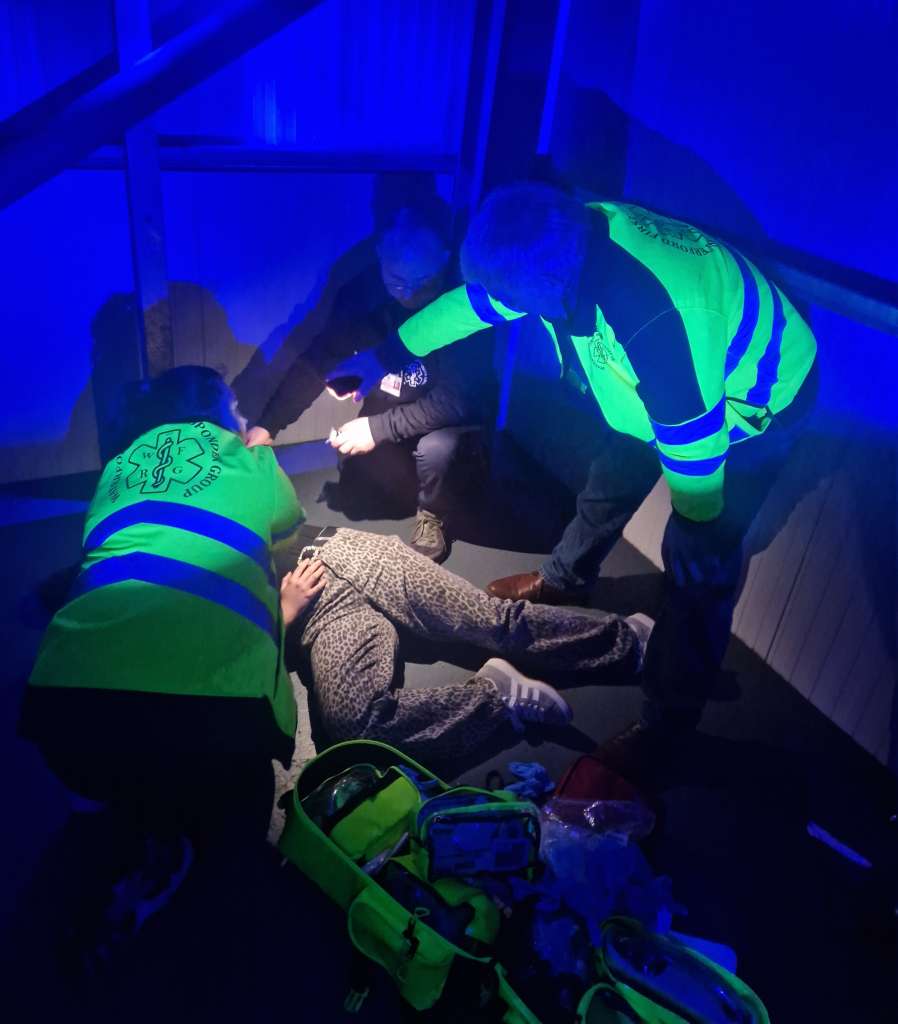
The Community First Responders (CFR) are a group of volunteers who respond to requests from the National Ambulance Service, when an ambulance may be delayed in getting to a scene.
CFR volunteers could be your neighbours or your work colleagues but they prefer to be discreet, so the first time you learn of their existence may be when they come through your front door to help.
Last week, The Munster Express attended a training event for the Waterford-based CFR group, which is run by Derek Burke, but according to him it is his wife, Sharon Burke, who is really the boss.
Derek retired two years ago from a 20 year career as an advanced paramedic. He explained exactly what it is the CFR group do and who they are.
“We respond to calls on behalf of the National Ambulance Service, we respond to a certain category of calls within a 5 km radius of Waterford City. Falls, strokes, cardiac arrests, choking, chest pains any kind of life threatening event, a lot of the calls can be quite serious,” said Derek.
“We go out in groups of three, for safety in numbers. The lads come from different backgrounds, this is not their job, this is not their Monday to Friday, we have security officers, we have people working in insurance, so they come from everywhere.
“At least if we send out three, then if a patient requires multiple people to move them, then the lads will be able to get them out.
“They don’t go into violent situations, they don’t go into assaults. They don’t go into known suicide events. It’s not their job.”
Derek also spoke to the difficult side of being a Community First Responder.
“A week before Christmas we had 8 cardiac arrests in 7 days.” He explained later that the majority of those patients would have passed away.
“We get a lot of people who want to get involved but they don’t understand the tasks they are being asked to do, or the psychological part of it. You go into a cardiac arrest kind of scenario, and people don’t know how to process it,” said Derek.
“This is life-changing, this is a very dramatic event. For the patient and the family this is the worst time of their lives ever, and now you’ve got someone who is relatively new giving them a compression. It’s not a very pleasant experience in the first place. It can be traumatising.”
Derek also outlined some of the group’s more positive outcomes, including an older woman who was bleeding-out recently due to a burst varicose vein and, in all likelihood, had her life saved by the First Responders who attended the scene until an ambulance was available.
There was also a case where First Responders provided chest compressions for 45 minutes until an ambulance became available.
Given the scenarios the volunteers are attending, it is not surprising that it can take a psychological toll.
“There is a National Ambulance Service aftercare programme, but we also do a lot of it in-house. A lot of the new guys I’d be ringing them after every call out. They can come to me at any stage,” Derek said.
“We also don’t go on calls on our own, we go in in threes. I know from my career about the psychological trauma. Plus I’ve had knives and bottles pulled on me, my wife used to be a Guard, she’s had shotguns pulled on her.
“In fairness, the group is well received when they go on calls, people love to see you coming, people love to get help.”
Covid and recruitment
According to Derek, Covid more than halved the number of CFR volunteers.
“We’re going since 2019. We started off with 35 members. There’s not a high turnover really, but Covid took away a lot of people. All of a sudden people were afraid to go in. The lads had full PPE so masks, PF3 masks, gowns, goggles, everything and overnight we lost over half of the volunteers. We’re down to about 11 now,” said Derek.
With the volunteers going out in groups of three, their numbers can be stretched, given the level of service they provide. Despite this, Derek explained that they are careful with their recruitment and, in terms of volunteers, quality trumps quantity.
“We only want people who are here to help,” explained Derek. “These are people who are giving up a massive amount of hours, they are leaving their Christmas dinners and going on calls. We don’t want people who are only looking for jackets, and bags and kits.
“And that’s one of our big no nos: if you doing anything like taking selfies at scenes then you’re gone, you’re out the gap. We don’t do that. We fly very much under the radar.”
“We have to be very picky, we have to look at the individuals we send in,” Derek continued.
“How are we going to put this person into somebody’s house. There is Garda vetting and multiple courses you have to do before you are allowed anywhere near the public. There is also a lot of training courses they have to repeat.
“We follow the National Ambulance Service and we have our own policies and procedures too.”
Positives outweigh the negatives
During the training event the CFR group were in the process of training three new recruits.
The newbies were being trained by Thomas Carbery, who works for a private ambulance service during his day job, and gives up his spare time to be part of CFR.
Thomas, speaking about the Community First Responders said: “The positives far outweigh the negatives and you get addicted to it”.
With some Responders leaving their workplaces to take calls, Derek was keen to emphasise how selfless and committed the CFR volunteers are.
“This is all in their free time,” said Derek. “They don’t even get petrol money or diesel money. They come up here and they get me hammering them for an hour,” said Derek. “They get absolutely nothing. Although we do events and stuff like that.”
Derek also paid tribute to the Summerhill Credit Union who provided the group with a donation last year.
Donations like these allow CFR to purchase supplies and equipment, like Annie the advanced manikin, who has an anatomically correct breathing system, allowing the group to practice on as near a real life patient as possible.
The group also simulated an emergency scene with blue strobe lights and sirens, giving the three newcomers the full sensory experience of what they may encounter.
It is likely the Community First Responders group will be holding fundraisers this year, please consider donating if you would like to assist them as they give their time and knowledge to assist others.
AARON KENT
Funded by the Local Democracy Reporting Scheme
