
Marcus O’Neill (36), formerly of 15 O’Brien Street, Waterford has been sentenced to life in prison for the murder of Tramore woman Gillian Curran.
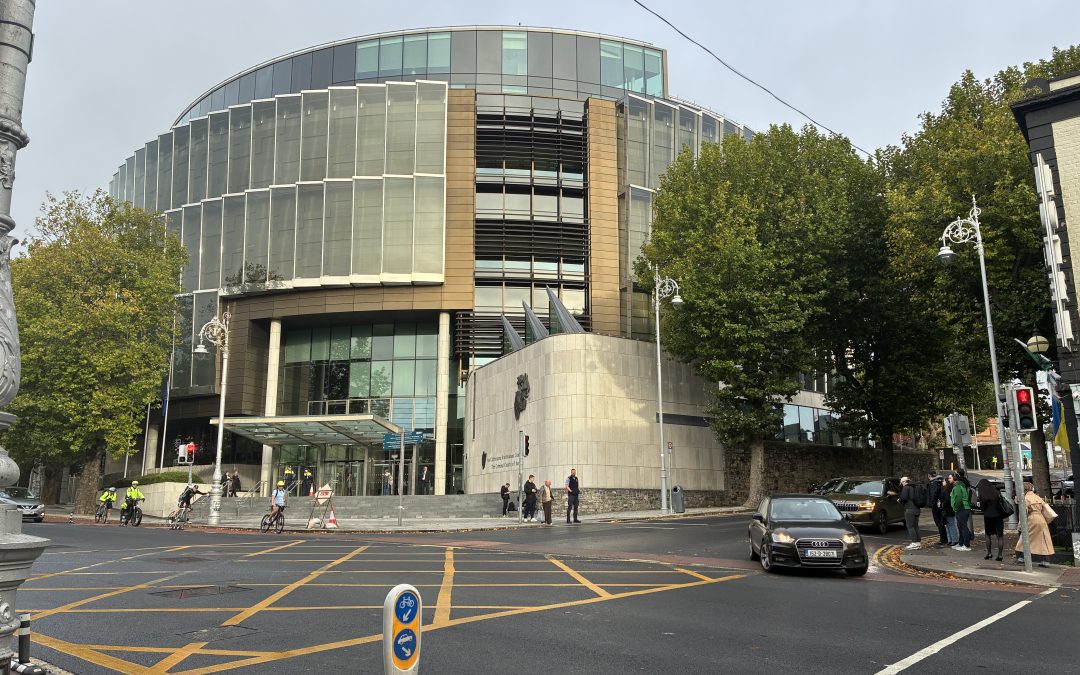
The sentence was handed down at a hearing before Ms Justice Caroline Biggs at the Criminal Courts of Justice, Dublin, last Monday 12 October. O’Neill had been convicted of murdering Ms. Curran following a three-week trial held in Waterford throughout July 2026. The jury of seven women and five men in the trial deliberated for a total of 12 hours across three days before returning a majority 10-2 verdict of guilty.
O’Neill had denied murdering Ms. Curran, who was his partner at the time, after she was found unresponsive at his home address on 25 January 2025. He claimed that she had fallen a number of times the night before when they were drinking together at the house, and he found her on the ground of the living room when he woke up and came downstairs.
He was represented during the trial by Roisin Lacey SC and Tom Giles Kelly BL, instructed by solicitor Derrick Connors. Conor O’Doherty SC and Niall Storan BL acted as prosecuting counsel on behalf of the state.
At last Monday’s sentence hearing, Detective Sergeant Mick Bourke agreed with prosecuting barrister Mr. O’Doherty that evidence presented in the trial suggested that the relationship between O’Neill and Ms. Curran was “volatile and abusive.”
During the trial, the jury of seven women and five men heard evidence from Gardaí who attended the scene, paramedics, neighbours of the accused who heard ‘aggressive’ shouting from the property and colleagues of Ms. Curran who noticed injuries to her throughout several months prior to her death.
Garda body-worn camera footage was also used as evidence for the first time ever in a criminal trial in Ireland.
Several expert witnesses also gave evidence, including Sandra McGrath of Forensic Science Ireland and Detective Garda Janette O’Neill, who both have expertise in blood pattern analysis, as well as State Pathologist Dr. Heidi Okkers.
Dr. Okkers stated that from conducting a post-mortem on Ms. Curran, she found her cause of death to be multiple blunt force trauma injuries, particularly to her head and abdomen, which were ‘most consistent’ with a ‘sustained’ assault.
The pathologist said Ms. Curran sustained 143 external injuries, such as bruises and abrasions, to her body, as well as several internal injuries such as a perforation of her small bowel and a laceration to her right kidney. Sgt Bourke confirmed to Mr. O’Doherty that this evidence was heard during the trial.
DEEPLY MISSED BY FAMILY
Members of Ms. Curran’s family were present in court for the sentence hearing, with some viewing the proceedings via video link. A victim impact statement on behalf of the Curran family was delivered directly to the court by her brother Michael.
Mr. Curran told the court that his sister was an “intelligent, loving and vivacious” woman, and is “deeply missed” by all of her family, friends, and colleagues.
He stated that she was ‘brutally taken’ and “did not deserve her violent end.” Mr. Curran stated that the trial process had a “profound effect” on the family, and they continue to be “overwhelmed by loss and deep sadness” following the death of Gillian.
He also described how O’Neill’s “complete lack of remorse, responsibility and complete indifference” throughout the trial was “beyond evil.” He detailed that their mother sadly passed away earlier this year, and they have been “unable to grieve properly” due to the ongoing stress of the court case. “We are only grateful that both our parents were not alive and spared the ordeal of the trial,” Mr Curran said.
Mr. Curran asked the court to consider the “deep lasting harm” that has been done to his family by O’Neill.

The late Gillian Curran.
In a statement following the jury’s verdict in July 2026, the Curran family said: “The past 18 months and in particular the last month have been harrowing for our family, and we thank all who have supported us throughout this period; it is much appreciated. We are not the first family to have to confront the effects of domestic violence, and we encourage people to support the work of organisations such as Women’s Aid, who are doing a brilliant job highlighting the issue and providing such important services to combat this scourge on our society.
“We will always remember Gillian with love and are happy that Justice has been served,” the family’s statement concluded
It was noted in court that O’Neill has six previous convictions, including possession of an article with intent to cause injury and obstruction. One of these convictions featured as evidence during the trial, relating to an incident that occurred in November 2023.
NOVEMBER 2023 INCIDENT
Detective Garda Kevin Cleere gave evidence of an encounter that he had with both Mr. O’Neill and Ms. Curran during the evening of 14 November 2023. Gardai received a call at 7.00pm from a member of the public who witnessed a man ‘drag’ a woman on O’Connell Street, Waterford city. Det Garda Cleere was one of the Garda members who attended the scene, and said when he arrived and spoke to Ms. Curran, she was ‘intoxicated’, had cuts to her knees, and her nose was ‘swelled’. She refused medical attention, Det Garda Cleere said.
The Detective Garda then moved to Bridge Street, where he observed Mr. O’Neill standing on the footpath holding a baseball bat in an ‘aggressive’ manner, which he refused to put down after being asked to. Mr. O’Neill was then arrested by Gardai, and told them he had dragged Ms. Curran down the road as he was in a ‘hurry’.
In his evidence, Det Garda Cleere added that he spoke to Ms. Curran numerous times after this incident. She attended Waterford Garda Station on 2 December 2023 and made a statement to explain that she didn’t want to pursue the matter. “He never in his life dragged me or hit me, I was wearing high heeled boots and he was helping me” Ms. Curran said in the statement.
Det. Sgt. Bourke agreed with Defence counsel Ms. Lacey that O’Neill was co-operative with Gardai at the scene at 15 O’Brien Street and at Waterford Garda Station when he was arrested. O’Neill answered all questions when he was interviewed, Det Sgt Bourke confirmed.

Marcus O’Neill, who was sentenced to life for the murder of Gillian Curran.
EVIDENCE FROM O’NEILL’S GARDA INTERVIEWS
During the trial, the jury heard evidence from Det Sgt Bourke relating to four interviews that were conducted with Mr. O’Neill across 25 and 26 January in Waterford Garda Station. In his first interview at 8.25pm, he consented for it to proceed without a solicitor, and told Gardaí he just wanted a “quiet life.” He also told Gardaí that he was on disability benefit, and had mental health and alcohol problems since he was a child.
O’Neill said that on the night of 24 January, he and Ms. Curran drank vodka and whiskey, with the deceased starting to ‘act weird’ after finishing a bottle of vodka. He told officers that the only argument they had that night was about going to the Credit Union, as he couldn’t go due to his friend arriving at the house.
“She fell at the kitchen table first, I tried to save her from falling but was losing power in my back, I was on the opposite side of the table, I tried to catch her but she fell fast,” O’Neill said in the interview. He additionally said he brought her upstairs to bed after she fell four different times, and when he woke up, he noticed blood on the bannister of the stairs, and that Ms. Curran was “destroyed with blood” when he found her in the living room that morning.
O’Neill further explained that he dressed Ms. Curran and cleaned up areas of the living room, as he “didn’t want to be looking at it [the blood]” and “just wanted to get it done fast.” He told Det. Sgt. Bourke and Det Garda O’Flynn that he “only knew she had passed away” when he was told by paramedics.
In the second interview on the morning of 26 January, Mr. O’Neill said: “I don’t want this to end up in the news articles.”
He continued to decline the offer of a solicitor, and he was asked why he did not call Gardaí or the emergency services when Ms. Curran firstly ‘fell’ on the 24 January, he told them he “didn’t want to be accused of assault and get false allegations” as he saw it happen with his own mother and father. “If you want to imprison me for false allegations, go ahead,” O’Neill told the officers.
When statements from his neighbours who heard aggressive shouting that night were put to him, he said they were ‘lying’. He continued: “No, I’m not guilty, I tried to help her and save her, you think what you want, I’m not responsible for her injuries. I never assaulted her once, nor would I towards a woman, my own mother went through it.”
It was also put to him during that interview that Ms. Curran’s injuries were ‘not consistent’ with his version of events, and he replied that he “wouldn’t say anymore” and just wanted to “curl up and die.”
O’Neill continued to maintain his version during the third interview, which was conducted later in the morning on 26 January.
Det. Garda Matt Donnellan was present and showed him CCTV footage from the 24 January, which the jury had previously been shown. It showed him locking the door of his house and holding hands with Ms. Curran with his right hand. He previously told officers he injured it by punching a wall on Newgate Street two nights before Ms. Curran’s death, and said in the interview he “could still do stuff with it” despite his injury. He said “I did not punch her, but I did punch the wall.”
He declined the presence for a fourth time during his final interview during the afternoon of 26 January. He was shown photos of blood on a skirting board in the property and he replied that it was there ‘ages’ when he “hit off” a cabinet.
Det. Sgt. Bourke told O’Neill that the results from a post-mortem examination carried out on Ms. Curran showed that her cause of death was blunt-force trauma injuries. He replied: “I did not assault her; there was no altercation. If anyone comes up to me and says I assaulted her, I will hurt them or myself, I’m not pleading guilty to something I didn’t do.”
O’Neill was formally arrested and charged with the murder of Ms. Curran at 6.06pm on Saturday 26 January.
Addressing the court, Ms. Lacey said her client is aware of the mandatory sentence for murder, and although “nothing can be said to change it”, she wished to put matters relating to his personal circumstances on the record.
O’NEILL ‘DOES NOT ACCEPT’ JURY VERDICT
The barrister said O’Neill was born in England to an Irish mother and Jamaican father, and moved to Ireland at the age of three. He had “a very difficult upbringing” by living with his mother in a derelict caravan and a women’s refuge in Waterford, before being taken into state care at the age of six.
Ms. Lacey told the court that her client was diagnosed with anxiety as a child, along with post-traumatic stress disorder (PTSD) and schizophrenia as a teenager, as well as having various learning difficulties. She noted that he has dealt with periods of ‘non-compliance’ with his medication, as well as having various hospital admissions.
The barrister added that O’Neill has never been employed due to his mental health issues and learning difficulties, and has additionally been homeless for periods of time.
Ms. Lacey concluded by stating that while O’Neill ‘acknowledges’ the grief, loss and pain suffered by Ms. Curran’s family, he ‘does not accept’ the verdict of the jury.
Ms. Justice Biggs thanked Ms. Curran’s family for attending and providing insight into the “clever and kind” woman that their ‘beloved’ sister was, which was ‘entirely consistent’ with evidence that was heard during the trial from her colleagues in particular.
The judge said it was clear Ms. Curran’s colleagues held her in ‘high-esteem’, noting how “funny and kind” she was, as well as “trusting and vulnerable.” However, Ms. Justice Biggs added that Ms. Curran’s colleagues also provided evidence of injuries they noticed she had sustained in the months before her death.
Ms. Curran worked in Brill Family Resource Centre, Ballybeg, Waterford city. One woman who worked with her for around a year said in evidence: “She [Ms. Curran] had bruises and cuts nearly weekly. After a couple of times, I realised she wasn’t falling over.” The woman described how Ms. Curran came into work with black eyes, cuts to her forehead, and at one point, a broken toe, which she said she sustained from a cyclist rolling over her foot.
The woman additionally told the jury about being in the work canteen one day with Ms. Curran. As they were talking, the deceased’s sleeve rolled up, and the woman noticed she had a bruise “almost the length of her arm.”
SENTENCE
During the sentence hearing, Ms. Justice Biggs also thanked Det. Sgt. Bourke and other investigating Gardai for the ‘high-quality’ evidence that they provided during the trial.
The judge stated that the court has ‘no discretion’ in determining a murder sentence as it is a mandatory term of life imprisonment, adding O’Neill “brutally beat” Ms. Curran to death, which led her to suffer 143 external injuries as well as several internal injuries including lacerations to her chin, a perforation of her small bowel and an axonal injury to her brain, which is regularly seen in victims of road traffic collisions.
This meant that Ms. Curran was “almost entirely covered in one injury or another,” the judge noted.
Ms. Justice Biggs imposed a sentence of life imprisonment on O’Neill, which will be backdated to when he first went into custody on 26 January 2025.
The judge also recommended for him to receive psychiatric assistance during his time in custody, given his diagnosis of schizophrenia.
Speaking outside the courthouse, Mr Curran said on behalf of his family: “We would like to thank the gardaí, the DPP’s office and the judiciary for their professionalism and kindness and for dealing with our family with such sensitivity during this difficult time.
“Today’s sentence is a step towards justice for Gillian, but we must also remember all the other victims of domestic abuse and their families. We must make sure their voices are heard and that no one is forgotten.”
Funded by the Court Reporting Scheme

Robyn Power
