
De La Salle teacher’s adventure revealed in 1916 letters project
A crowd sourced humanities project which aims to create a digital archive of letters sent to and from Ireland around the time of the 1916 Rising has stumbled upon a quirky tale of an intrepid teacher with Waterford connections.
The project, initiated by Professor Susan Schreibman of Trinity College Dublin, seeks to construct a detailed portrait of the “written, last, unspoken and forgotten words” of an Irish community and Diaspora during a period of arrest and upheaval.
While the 2,500 letters collected to date have done little more than take a snapshot of a nation under immense change, correspondence surrounding the Kilkenny born and De La Salle educated teacher Martin Kennedy have traversed that: opening a hidden chapter of South American adventures, iron mongering, military inventions and Wall Street investments.
The transatlantic correspondence initially uncovered by New York resident and great-niece to Martin Kennedy, Noreen Bowden, is succinct, revealing little about the impact of The Rising in Waterford city other than “a rumoured censorship of letters.”
However, it was a list of grades and qualifications sent by a Brother Ignatius from De La Salle College to a South American-bound Mr Kennedy that piqued Noreen’s interest most.
“We had a vague notion that he was a very intelligent man,” says Noreen.
“My mother used to say that he ‘taught English to the gauchos on the pampas,’ but we never really believed that he travelled outside New York after moving from Ireland.”
Whether it was the ambiguous nature of Brother Ignatius’ letter or Martin’s enigmatic and “slightly intimidating manner”, Noreen was hooked, eager to discover more about the man she knew so little about.
Looking beyond his Waterford correspondence, Noreen, who lived with Martin in his latter years, discovered among his personal belongings a trove of documents, letters and business cards “from his life in the Americas and his arrival in New York, through to his years in Argentina, Nicaragua, Ecuador, Peru, Chile and his return home.”
The earliest papers document Martin’s passing through Ecuador and Nicaragua while on his way to Lima, Peru.
There, Martin utilised his local connections to work for Eagle Iron Works, an enterprise operated by Kilkenny’s Grace family, who immigrated to the region during the Great Famine. Despite his, it seems that the grind of the iron works suited the teacher, who went on to become a prominent Wall Street shareholder of the business in latter life.
But Martin’s fondness for the ironworks can only have been fashioned from hindsight, as after just three months he travelled onto Chile to work as a draftsman for an exportation company – an as of yet untapped skill acquired from his days at De La Salle.
Documentation from Martin’s time in Chile is sparse, but we do know that he spent twelve months in the capital before moving to Buenos Aires.
There, he would spend the bulk of two years teaching English in the Berlitz Academy, before educating through Spanish and English in its rural hinterland, ringing true to her mother’s phrase that he “taught English to the gauchos on the pampas.”
Despite his far-flung whereabouts, Martin never lost sight of his Irish roots. His weekly, if outdated copy of the Kilkenny People enabled him to keep track of an increasingly unstable political tug-o-war: a crisis that served to strengthen his Republican stance, and one that formed the basis of several poems he penned that championed Irish independence.
Martin called time on his South American adventure 11 years later, returning to New York in 1928 where he would continue to surprise by inventing and engineering mechanical devices for the US military between spells of teaching Spanish in his local school.
Teacher, inventor, blacksmith, draughtsman, multi-linguist, educator, poet, republican and intrepid traveller, Martin Kennedy truly was a renaissance man.
But one factor intrigues Noreen above all else. “For me, the mystery is how he managed to hold onto these documents throughout his journeys, and then through several apartments across New York City. That I cannot comprehend.”
Emma Clarke, Outreach Coordinator at Letters 1916, is currently searching for additional letters from the period around Easter 1916 (particularly those in Irish) to upload to the online database. To contact the project, email: letters1916@gmail.com
Honoruing TF MEAGHER and the TRICOLOUR
Reverend Michael Cavanagh, chair of the Thomas Francis Meagher Foundation which promotes pride in and respect for the Irish Flag and its meaning for peace, welcomed the Flag raising ceremony in Dublin Castle on New Year’s Day in Dublin Castle.
In the presence of President Higgins, the Tricolour was raised at the first official State ceremony for 2016.
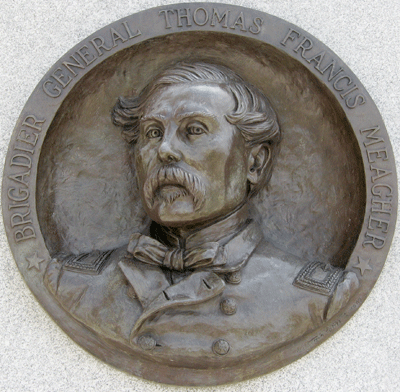
Thomas Francis Meagher: father of the Irish Tricolour
With the assistance of the TFM Foundation, the flag being used in last Friday’s ceremony has previously been flown over 33 the Mall in Waterford where Thomas Meagher first flew the Irish Tricolour in 1848.
Reverend Cavanagh explained: “The Irish Flag and its significance is as important today as it was when Thomas Meagher first raised it and explained its symbolism in words of great significance: ‘The white in the centre signifies a lasting truce between orange and green. I trust beneath its folds the hands of the Irish Catholics and the Irish Protestants may be clasped in generous and heroic brotherhood.'”
He welcomed the new additions to the protocol and guidelines of our National Flag. The first tricolour was raised on March 7th 1848 and flown continuously day and night until removed by the authorities.
On Easter Monday 1916 it was raised for the second time, again flying by day and night. This year will be the first year that protocol will allow for the flag to be flown at night – provided it is illuminated – so it is entirely appropriate to fly the flag with pride and respect at all times.”
Throughout 2016, there will be ceremonies, events and programmes marking the significance of the Flag in the historical and cultural narrative in the 100 years since the Rising, with a particular emphasis on conveying its message to the nation’s youth.
