
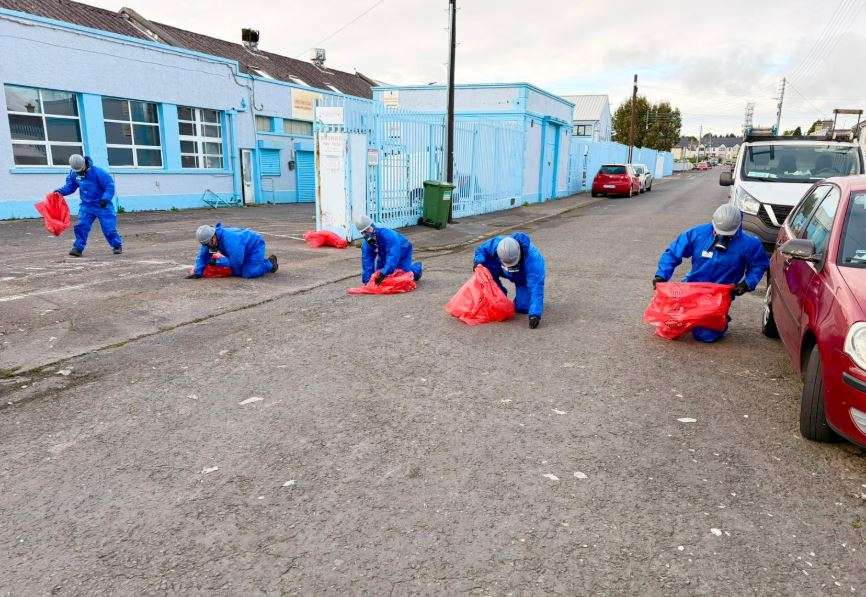
While the world moves on, those affected by the Jute Factory fire are still trying to recover from the damage.
In such dramatic events it easy to overlook mundane matters like who picks up the bill once the clean-up is complete?
According to Councillor Mary Roche, who raised the issue at the June Plenary meeting of Waterford City and County Council, the cost of the clean-up should not fall on the Waterford public.
“I know we are being reimbursed by the Department for the clean-up of the public area,” she explained. “But are we claiming that under the insurance of the owners of that premises? I don’t think the public should necessarily have to pay the price of that clean-up, if the insurance covers it.”
Waterford Council CEO Sean McKeown commented that he was immediately alerted to the potential costs of the clean-up once he became aware that Waterford was dealing with a major fire.
“The clean-up is now completed,” he told the Plenary Council. “In the early hours after the aftermath of the fire breaking out, I reached out to the department, knowing that the nature of this fire was such that there was going to be a major clean-up operation involved and a major cost involved,” he said.
“We got reassurance from the Minister and the Department that they won’t be found wanting in relation to those costs.”
Mr McKeown went on to explain that if liability was found by the insurance situation could have further developments.
“Now it has to pan out whether or not there is an insurance liability as well. But, my first and foremost concern was that this council would not be liable for any of those costs.”
Financial supports
Acting Director of Services for Economic Development, Ned Brennan, provided a breakdown of the progress on the financial support scheme, explaining that three applications from Jute Factory businesses were deemed ineligible.
Speaking at the June Plenary meeting, he said: “At this point in time we have received 19 applications, of which 13 are coming in under enterprise and 6 are coming in under community.
“Of those 19, there were 3 that were ineligible. The other 16 are being processed at the moment and out of those 16, 9 have received the initial payment. Four have been processed and approved for payment and that payment will be processed in the next couple of days.”
Mr Brennan also said the assessment for the larger amount of supports was ongoing. The Tycor support package offers one-off financial support of up to €30,000, a loan scheme offering up to €50,000 is also in the works.
“The assessment for the larger amount of money, we are in the process of appointing loss adjusters … to carry out the second phase of the application,” he continued.
“A third part is providing support for the existing businesses. All of the businesses were provided a mentor, to assist them in preparing a financial application and also assistance in relation to sources alternative accommodations.
“On the economic development side, we have been examining premises that have been offered to us to determine their economic suitability for businesses that are affected.”
Cllr Mary Roche followed up by asking why three applications for the Tycor support fund would be deemed ineligible.
Mr Brennan replied: “They were entities that couldn’t prove that they had suffered any loss.”
AARON KENT
Funded by the Local Democracy Reporting Scheme
