
AARON KENT
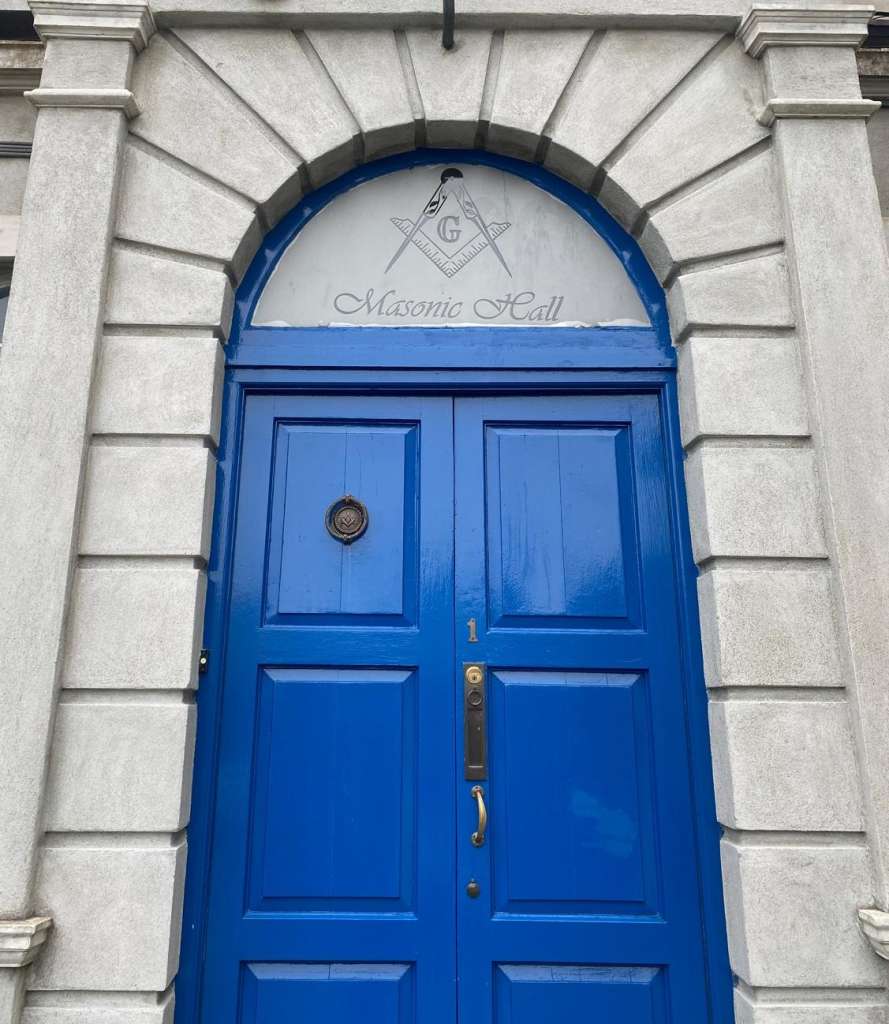
Last week, The Munster Express attended the Freemason’s Lodge 32 in Waterford to speak with the Provincial Grand Master and the Lodge Secretary, both senior Master Masons of Irish Freemasonry.
Although it may once have been a truly secret society, Freemasons are more accurately described as a society with secrets.
Established over 300 years ago, Freemasons have long been a source of intrigue and mystery. Famous members of this men-only fraternity with symbols, rituals, private halls, and ceremonial attire, include George Washington, Winston Churchill, Mark Twain, Benjamin Franklin, Henry Ford, John Wayne, Shaquille O’Neil, and Ernest Shackleton, along with many more influential figures who have kept their membership private.
This is one of the most in-depth interviews ever conducted with Irish Freemasons, who were generous in sharing their time, knowledge and experience.
What is Freemasonry?
“It is a system of morals – with a lot of symbolic meaning in it. We use a lot of symbols with old fashioned rituals to explain it all. It comes from before the widespread publication of books.
“Our ritual contains all this old-fashioned language, but it contains a moral message of trying to take a good man and make him better. That’s the essence of what we do,” the Provincial Grand Master told The Munster Express.
The symbols, oral tradition and rituals are the practice of Freemasonry, is that right?
“Yes. Every meeting has a formal opening and a formal closing and the bits in-between we have administrative things like what were the minutes of the last meeting, if anybody sent in an apology, who’s ill, who has died, and then correspondence, and degrees for candidates—when they join the craft they go through three degrees.
“The officers all change once a year, and it’s a rotation. So, you should get to be in the chair of Worshipful Master if you want to be. The Worshipful Master is the governor of the lodge.
“The outside world will influence us, inevitably. Our ritual has old fashion wording, it’s not modern English, it’s English from around about 100 odd years ago. We are little bit keen on retaining those old words and old ritual, and that adds a bit to the myth.
“We are quite rooted in our tradition. We don’t really have a revolution, we evolve. We have only computerised in the last 10 years.”
So, you are not early adopters then?
“No. It has to do with things like fashions and fad. There was Betamax, VHS tapes, CDs, DVDs, and now its downloads. The lifespan of those things has been about 20 years, and to some extent that’s why we are a bit slower.
“When something has been going for 300 years you value the longstanding nature and you are conscious that you don’t want to do something that ends things rapidly—you don’t want to be that man.”
So you have a sense of obligation?
“I think you do. But that’s not just prevalent in Freemasonry, it’s anything that’s long standing, like churches or a religion, you don’t want to be the one that ends it.”
Are there secret codes, handshakes, ways of recognising each other?
“Those are our secrets actually, and that’s it. That’s the core of the secrecy: how we recognise others have reached a certain degree of Freemasonry.”
Do you recruit?
“No. I will say a firm no: you cannot ask a person to join because they must come of their own free will, because if you ask you are putting pressure on them.
“If somebody expresses an interest, we are quite willing to talk to them.
“But nowadays you get quite a lot of people who send in an application to Grand Lodge on their website. If you are interested, you can fill out your details and somebody will contact you.”
What proportion of applications would you expect to be successful?
“About 50%.”
Is there a vetting process?
“Yes. We get you to fill out an application form which will ask you certain questions. Then three members of the lodge will visit you. They will chat to you to make sure you understand, as best you can, what you are getting into—and also to see if you are a good-humoured person, and to answer any questions. We try and dispel any fears people might have in joining. They report back to the Lodge, and the Lodge takes a vote.
“There have been people we felt would not have been a good fit.”
Is that character-related, or professional?
“It’s not professional. We’ve got a mason, as in a bricklayer, we have quite a number of people in the IT area, we’ve had people who run businesses, a couple of clergy.”
What is the age range of members?
“You have to be 21 to join. There are members who are knocking on the 100-year door.”
Would you get many people in their 20’s?
“Since COVID, we’ve got a few. The demographics have changed, especially here in Waterford for some reason.
“When I joined masonry in the mid-80’s it was all Irish people. Now we’ve got three Brazilians, we’ve got a Frenchman, we’ve got 4 Scottish people, an Englishman, a Polishman, a Kosovan, an Indian. Some of them are late 20’s into their 30’s.”
So, despite the conservative appearance it is a diverse organisation?
“Ideally, it should be. For some reason after COVID there was a renewed interest, we don’t know why.”
Is there a reason women are not allowed in?
“Nowadays there are two similar organisations specifically for women. So nowadays if a woman writes we refer her to those.
“But I don’t know. Three-hundred years ago a socially conservative attitude was fairly predominant. That’s probably how it arose. We are a reflection of society. Like I say we evolve rather than have a revolution, so we are probably a reflection of slightly behind where society is now.
“But there are members who are in same-sex marriages. That’s fine, it’s up to them, it’s their business. It is a reflection of modern society and modern values. Perhaps we are not quite at the forefront, but we are certainly not lagging several generations behind. We always have to comply with the law as well so that inevitably makes changes happen.
“Most people would look at it and say ‘does love have to be male and female’ —probably not, so therefore does it matter? Again, it’s reflecting societies values.”
Rules and Expectations
What does matter then, is there conduct of individual Masons that’s expected?
“Obey the law, obey the laws of the supreme being according to your religion.
“Basically, treat everyone fairly.
“Once you say you believe in a single God, how you believe in that God is between you, your God and your conscience.
Does that God have to be in a religious text?
“The only requirement is that you believe in a supreme being. We avoid using God because that is a Christian supreme being. I know Sikhs have multiple Gods, but they have one big God, that’s the supreme being, so they are quite happy to become members.”
So, if you believe in multiple Gods, like paganism, you would not be a good fit?
“Ideally not. Paganism is a big no. My understanding is that’s because they do not believe in an overall supreme being. If somebody can correct me on that, that’s fine I will learn and listen.”
Why are multiple Gods unfavoured, is conflict more accepted in those religions?
“I don’t know. I sometimes think it is because we are over 300 years old and I sometimes think that 300 years ago everybody around England, Wales, Scotland and Ireland would have been Christian. Therefore, there would have been no thought of something other than a single God. It could be something as simple as that. It’s one of those things lost in the mystery of time.
“You look around and you figure presumably in other places where there is more dependence on other Gods, more than one God, maybe they have a different view of social structures.”
But Freemasons believe there is a judgement day before a single supreme being?
“Oh yes absolutely. One of the things Freemasonry teaches you is how short life is. In terms of the universe, human life is short. So be prepared for what takes place that is going to last a long time once you die.
“Another symbol of ours is the level. All men are level: born equal, suffer the same illnesses, die the same, and will be judged by the all-mighty the same. Any distinction that may exist outside is dropped at the door.
“I first got introduced to the Marquis of Donegall just as Dermot. Picked him up in a car, spent two hours driving to a lodge meeting, spent two hours waiting there and then someone said the Marquis of Donegall is here and he stood up. I had just spent two hours chatting to him as Dermot.
“He was very high up in Freemasonry, he was a former Grand Master, so he was the over everything in Ireland, but he just introduced himself as Dermot.”
If somebody was being immoral, would that be an issue?
“It depends on what they did. We are almost reluctant to judge a person but at the same time we know you have to judge a person. It’s a bit like the law, you park on a double yellow line, ok it’s a crime but is it a big crime? I don’t think it offends many of us or many in the public but it’s not legal, you shouldn’t do it.
“If someone committed a violence against a woman that would be serious and they would not be supported.
“That would result in a court case, and we do believe in innocent until proven guilty, so we would suspend [the member] until the court case had happened before we exclude.
“We don’t have the power to investigate, we are here as a social fraternity, and you are in friendship and company. But your definition of a serious crime could be different than somebody else’s.”
For example, a delinquent landlord that was profiteering off misery?
“That would not be Masonic behaviour. We would be upset by that. But we also have to be fair, and we would hear what the landlord has to say.
“In cancel culture you hear one side of a story, but before the modern digital age you would always wait for the court case and hear the other side of the story. You might not agree what the court decides but that’s the decision. Now there is a lot of people very keen to act early. For us that’s a slight conflict. We prefer to evolve, we prefer to be a little more considered, we prefer to wait for the criminal system to find its result.”
Are members required to do a certain number of good acts?
“No. We recognise that everybody is different. My skillset isn’t going out and standing on a street corner trying to raise money. Whereas some of the other members would be good at that. So, we try to make use of people’s skillsets.
“There’s no record of who gives what. The charity bag is anonymous. We have this rule that says don’t give more than you can afford to give.”
Can poor people be successful masons?
“Oh yeah, income is not relevant. Everybody is one a level. If you are out of work and this month you can only put in a €1 coin that’s fine but in six months you have a new job and are earning thousands and you want to put in €50 that’s fine. That’s what you can afford in your conscience.
“While we promote things that are Masonic, family and jobs come first.”
If a member did act against their family, say adultery, would other members take issue?
“Adultery per say, no. But adultery against another Mason’s wife or daughter yes.
“Adultery happens and always has happened. People wonder if it is human nature, I don’t know what it is but it occurs. As of itself, it is not necessarily a major issue.”
You mentioned acting against another members wife or daughter.
“That’s supposed to be automatic exclusion,” said the Waterford Lodge Secretary.
“It does also say other close family members. In that sense, the old-fashioned ritual probably by accident does cover non-female members as well.”
But it particularly names female family members?
“Yes. And again, 300 years ago they probably would not have thought of homosexual acts, even though they were around.”
Was Oscar Wilde a Freemason?
“He was. And society wasn’t kind then. There will be something we are not kind about now, in 50 years’ time you’ll look back and go yeah, we shouldn’t have done that.”
Are there any other offences that would be automatic exclusion?
“Murder and treason.”
Freemasonry and Politics
There is a belief, that Mason’s work together in the outside world to get high up in companies and give each other political advantage. Is that true?
“No, we try not to. That’s not an aim. I’m not going to set up a company to recruit another Freemason. Freemasons could always apply, but in that sense it’s no different than say a GAA or football club, you may be more likely to give people a job because you know them.”
So, it’s not against the rules to work with each other in the professional world?
“No, we can do that. The only rules around that are during our meetings we don’t talk religion or politics. They cause dissent.
“If you look at a lot of wars it’s about religion about politics. That’s why we try and avoid it. That way you can avoid some of the contentious subjects that might arise.”
Is this considered a sacred building, legally?
“No, we pay rates on this building.
“We don’t have a religious aspect in that sense. We get a concession here in Waterford because the Council accepts that one of our main aims is to raise money for charitable purposes. We are not a charity, but a charity bag always comes around.
“During the summer we might have barbeques or fundraising events. Some of it goes into Masonic charities. We have a widows and orphans aspect for the families of former members. We also fund money for external bodies.
“Lodges here will give out money to local RNLIs, or this year we did Alzheimer’s, but we also top up our widows and orphans aspect internally. It’s also educational internally.
“Some of the internal charities also donate to charities that are doing research into cancer.
“In the past we’ve had Grand Master festivals, where all the lodges in Ireland raise money and send it to Grand Lodge. They hope to raise significant funds. Medical research was funded by the first one.
“The last charitable effort was, unfortunately, cut short by COVID, which got in the way, but we still raised between €250,000 and €300,000 nationally.”
Do you fret for where society is going?
“I think that’s down to a personal aspect. We don’t talk religion or politics, but we follow religion and I’ve voted in every election I’ve been entitled to.
“I wouldn’t say as an individual I don’t fret, but as an organisation we are not political. In conflict we would push for calm and negotiation.”
What makes a successful Freemason?
“Some of it is friendship. You come and meet people; it’s a social thing.
“Men struggle with these social relationships. Here it is all friendly. But you’ve got the thing that’s called the ritual, which is a conversation starter. It is a weird thing that we do but it opens conversations up, like did you enjoy it, that particular part, and they say yeah but what did it mean. You suddenly get these questions and answers, and the conversation builds so with a complete stranger you’ve suddenly become in conversation.
“If you go into a café or into a pub you might sit in the corner and not talk to the other strangers. In a lot of senses, the ritual provides that common conversation.”
To conclude the interview, the Provincial Grand Master and Secretary of Waterford’s Lodge 32 confirmed that the Freemasons had no part in sacrifices, although they may, jokingly, have text a new member saying an animal is being prepared for their initiation.
