
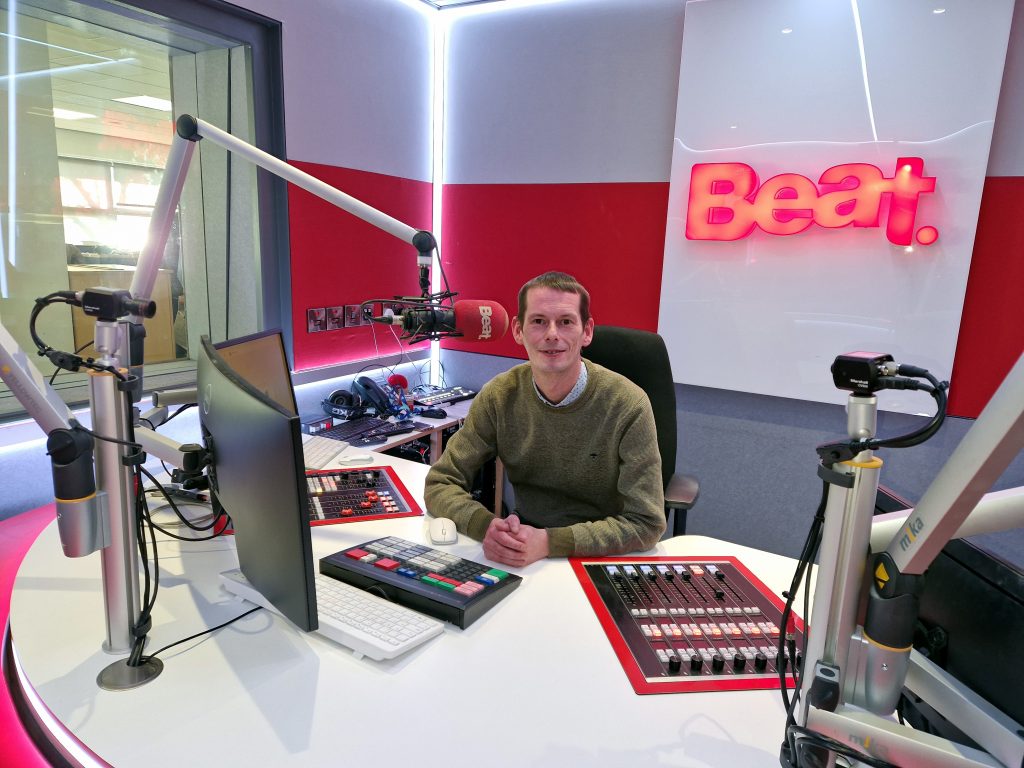
Niall Power has been waking up Waterford and the south east for the past 20 years as host of Beat Breakfast.
He started in the fledgling youth radio station Beat 102 103 when it first began broadcasting in 2003 and worked in current affairs for three years, before moving to presenting the early morning breakfast show on 13 February, 2006.
Fast forward 20 years later, and Niall Power is still going strong, getting up early (even though he admits to being a ‘night owl’) to entertain the south east with current co-host Shonagh ‘Sho’ Lyons.
Last Friday morning, 13 February, Niall and Sho were joined on Beat Breakfast with former original co-hosts, Vincent ‘Vinny’ Bradley and Mary O’Neill, for lots of chat, fun and a trip down memory lane, as they celebrated Niall’s two decades.
Recently, Niall sat down with The Munster Express to chat about his 20 years presenting Beat Breakfast.
Niall is quick to point out that he has worked with some really brilliant people in the studio over his 20 years in the breakfast show.
“Originally it was with Vinnie and Mary and then it was Vinnie and Trish [Trishauna Archer]. And then in the last couple of years, Sho has been my right hand woman. She's a ‘Wexican’, as we say [from Wexford], so we battle over everything,” said Niall, speaking to The Munster Express.
“It's really important in any workplace to be comfortable with people around you, and myself and Sho have such a great relationship. We've got record listenership figures at the moment. And the audience is really responding well.”
Latest JNLR figures shows that Beat 102 103 reaches a record weekly audience of 187,000 listeners, with Beat Breakfast reaching a record audience of 59,000 listeners daily (and increase of 26 percent compared with the previous year).
Early mornings
Getting up really early in the morning for the past 20 years hasn’t bothered Niall.
“In the mornings, I'm always tired, but I still don't mind getting up early. I just love breakfast so much – we've all got to get up at some stage, and if I have to get up before six, that’s grand. The funny thing is I am naturally a night owl. Because I worked late nights in Dublin for six years, and if I had two weeks off work, I'd be up until three or four in the morning and lying in, that's my natural body position,” he said.
“It's tough at this time of year in January, February, but in the summer, you're jumping out of bed because it's bright at 5.45 am.”
Always wanted to be a radio presenter
Niall, born and reared in Waterford City said he has always wanted to be a radio presenter “since I was about eight or nine years of age”.
“I started practising in my living room at home, being a radio presenter and wrecking my family's head.”
When Niall was older, he attended college in Dublin and later got a placement in 98FM working in the news team.
“It was really interesting because it was the summer of 1997, and a lot happened. Princess Diana died, and Bertie [Ahern] came to power, so I was out on a lot of stories. Then I started working on their night-time talk shows as the producer.”
At the time youth radio was just coming into fruition and the first ever regional radio licence was offered for the south east. Niall made his way back to Waterford and starting out in Beat in 2003, co-presented an afternoon current affairs show called ‘Beat Talk’ with Patrick Haughey.
“We were told at the time, young people don't want to listen to talk and current affairs. They wanted music and entertainment. So we kind of came up with a really original format for the show. It was called Beat Talk, and what we did was we built it like a music playlist with a four or five-minute topic and we would move on, so even if you weren't interested in the current topic and your attention span was short, you'd have something different coming very soon. Which put a lot of pressure on us, because it was just two guys working on the show, and we might go through 15 topics in two hours – we’d have a politician first, and then a celebrity and then an expert next. But we had a lot of fun, and when the first JNLR figures came in, we were the biggest show on the station. So we kind of disproved the theory that young people don't want to hear talk, and news and current affairs. So I did that for about two and a half years, and it was a huge success.”
Moving to breakfast
Niall was approached to do the morning breakfast show on Beat.
He explained that in radio, breakfast is everything. “You get your audience first thing in the morning, and hopefully they'll stay with you for the day, because if you don't get the audience in the morning, it’s a task trying to win them later in the day.”
“I said I'd give it a bash,” Niall said. “Initially, we still had more of an interview and current affairs tone to it, but as time went on, we realised what the audience wanted and over the years we've became more light-hearted conversation that could still kind of have a current affairs feel to it, but it's not politics, it's more lifestyle relationships, which is really perfect for the target audience being 15 to 34-year-olds.”
The nature of the breakfast show is caller-driven, meaning Niall and Sho come into the studio in the morning not knowing what to expect.
“We start a conversation, but then the callers come in, and they do their bits. So, there's always kind of the unexpected, and we thrive on that,” said Niall.
“Myself and Sho really love the fact that there is a little bit of the ‘seat-of-the-pants’ stuff with the show, that it's not as regimental as an interview-driven show, where you know what you're doing every 15 minutes.”
One of the most successful segments of the breakfast show is the Daily Dilemma.
“That would be where those kind of big moments come out of, where you just didn't expect it,” said Niall.
“People have told some really shocking stories on air, because we're obviously famous for the Daily Dilemma. And some of the stories they've told – people love to come up to me in the pub afterwards when I'm out and sit down and just start talking about it.
“But, there's another side to that, too. Sometimes you have some really sad stuff that happens on air, where somebody breaks down over a story, and you weren't expecting it. And that's difficult, because you've got to coax them through to the other side of the interview. You still want them to be able to tell the story that they're telling, but they're very upset. So, we've had those moments, too.”
Looking back, is there anything Niall would change?
“I'm never a big fan of trying to rewrite the past, because everything shapes what comes next. I'm a big believer in all that kind of ‘sliding doors’ stuff. I suppose because I'm so happy with how things turned out, I'd say no.
That there isn't anything that necessarily I would have changed. Small things about people I worked with at times and could have got more out of that relationship or whatever. But nothing major over the years, I have to say.
Most memorable moment
“We've done some really crazy things because of the nature of the kind of station we are,” said Niall.
But, one particular defining moment was in 2009 (long before the big TV shows) was ‘Two Strangers and a Wedding’.
People might remember the wedding experiment where a guy and girl tied the knot live on air – just minutes after setting eyes on each other.
“And the interesting thing about that, myself and my co-presenters, Vinnie and Mary at the time, we didn't see the couple either,” reveals Niall.
“They were behind screens, so we didn't see them until the moment they walked down the aisle. We had that genuine listener reaction to it. To do a wedding and commentate on it at 8.00 am on a Monday morning just seemed quite surreal.”
While it was a bizarre and unusual radio experiment, Niall said they did receive some flak for it.
“A lot of people thought we were making a mockery of marriage. And I remember there was a 500-word opinion piece in the Sunday Independent about why our boss should be fired.
“I walked to my local shop the Sunday after they got married and I looked at the newspaper stand, and three of the tabloids had the bride on the front page. So, it was wild. It was tough, but, it was absolutely memorable. It was the six weeks where this wedding just took over the show. So, that's probably one of the big ones for me.”
Connecting with the audience
“We worked with a very wise international radio consultant, Phil Dowse, when I started on The Breakfast Show and he said to me, ‘every hand that you shake is a loyal listener’, because they've met you and they feel they know you, rather than just a voice on air, so, that's where we get out as much as we can,” said Niall.
Niall said that Beat is very much an “out-and-about” type station and one of the things on Breakfast they’ve been developing is their live show ‘Daily Dilemma Uncensored Live’.
The first live show they held this year was last Friday, 13 February at the Set Theatre in Kilkenny.
The next Daily Dilemma Uncensored Live show will be held at Bank Lane, Waterford, on 28 February, 2026.
“So it's kind of the rude show for over-18s with some sex talk,” explained Niall.
Beat also have podcasts of the Daily Dilemma Uncensored, “to talk about things that we couldn't talk about on a family breakfast show”.
“They're very popular and that developed a whole audience of its own. It was really bizarre where people used to come up to me and talk about the show and now they want to talk about the podcast. It was our most successful ever podcast.
“So the natural step then with podcasts was let's do a live show. That's a great opportunity to get a couple of hundred listeners in a room and we'll spend time with them and shake hands and build a personal connection. Because a lot of listeners like to know that you are the person they hear on air, that you're not putting on any kind of front or exaggeration. So, anytime we can meet them and spend time with them, we will do so,” said Niall.
Niall points out that many of the Daily Dilemmas are bizarre and ‘out there’, “because there's only so many times you can do cheating or those kind of heavy ones”.
“We are always looking for the ‘out there’ ones because they're the ones that we get entertainment out of. We can have a good laugh at. So we always say the wilder the better or the smallest little thing that you're fighting with your partner over, tell us and we'll have a debate about it,” he said.
“At the end of the day, it's 8.30 am, it's raining, people are stuck in traffic out there. They just want to smile. It gets people talking and they go into work and they have a bit of crack about it.”
Niall reveals that one particular company which holds its staff meeting at 9.30 am every morning has the Daily Dilemma as the first item on the agenda.
Advice to budding young presenters
“It's probably my most passionate work – working with younger people getting into radio and starting out. And we just kicked off our ‘Introduction to Broadcast’ course with SETU,” said Niall.
“There’s Learning Waves and loads of other opportunities. Simple advice I always say, get experience wherever you can – volunteer at a community station, there are a couple around the place, college radio, hospital radio, even making the tea at WLR or Beat or whatever. Just get in the door, and learn. That's essentially what I did on that first work placement. I just soaked up everything around me. Get in and get as much experience as you can. If you can do a course, do, but they're not the be all and end all. A lot of the demos I get from people who've done four year courses, they're actually further behind the people who didn't because they're trained in a certain way that doesn't suit all radio stations. So it's really about experience, contacts and put yourself out there.”
Changes in radio over the years
Niall agreed there have been huge changes in radio since he began working in the industry in the late ’90s.
“When I was getting into radio, you were very much a voice and maybe a name, so, you could live a completely anonymous life as a radio star, but obviously, the world of social and digital took over,” he said.
“And while we are a radio station, we are also a multi-platform organisation. What we do on social and digital is equally as important as what we do on air, even though radio is our bread and butter. We do find now we're producing as much content for video and for online as we are for on air.”
How people communicate with the radio station has also changed over the years.
Niall explained: “Originally you'd have to ring a radio station if you wanted to get a comment on air or a request, and then texts came in. Now we're solely reliant on WhatsApp”.
“We don't have a phone number or text any more. You can either text us on WhatsApp or a voice note, and we do all our calls through WhatsApp. That whole kind of technology has changed. But also, people can interact with us on all the different social channels. We have the biggest TikTok following for a radio station in Ireland. People can message us, DM us on Instagram and Snapchat. So, there's so many ways that people can actually interact with the radio station now. That's been a big change. That makes them feel part of it and part of the conversation and the presenters. It makes them feel just a bit more personal and a bit closer to the radio show and the radio station.”
The news at ten minutes to the hour
Broadcasting the news at ‘ten minutes to the hour’ was another thing that Beat was notable for when it first started out in 2003, but it later changed to the regular news ‘at the top of the hour’ like other radio stations.
“The original idea was that we would be into music by the time every other radio station was doing the news, so if you didn't like the news and you'd flick around, we were the one place that gave you the music,” said Niall.
“But it was mostly for commercial reasons to move to the top of the hour, in terms of standardising it across our network, where they could place ad breaks and that kind of thing. And there are times where we will take network news. We have a full-time news team, but early on weekend mornings or sometimes on bank holidays, we'll take the network feed from News Talk, so we need to do that at the top of the hour to take that in live. So it's just a few practical reasons why we did it. But, it was fun while it lasted.”
Tuning in
Getting younger people to tune into radio is much harder these days, with other formats competing for the attention of young ears.
“When I was growing up, you had two choices for entertainment at home – you can either sit in the living room and watch what your mum and dad were watching on telly or you can go to your room and listen to the radio. And we didn't have streaming,” Niall said.
“So, you didn't have the world of music at your fingertips. You might have had a few tapes or albums. So, the radio really was important to younger people. But now, people have so many options for their time and the phone provides so many options.”
Traditionally in radio, competition would have been the other radio stations, but now, they face competition from the likes of TikTok, Spotify, Snapchat and YouTube.
“Anything that takes their time on the phone, that's taking them away from radio, is the competition. So, there is no denying that it's tougher and we have to work harder,” said Niall.
“But, in terms of why everybody comes back to radio, I think there's an old line that radio was the original social network, where you could get a bit of everything. You could find out what's happening in your locality, you can get a bit of entertainment, you get a bit of news, chance to win some prizes, some good music, and just a sense of community.
Demograph
While Beat’s target audience is 15-34 year olds, they retain their listeners even after they turn 35 and older.
“When I was a teenager, my parents felt like such a different generation. We wouldn't have the same shared interests or whatever. Let's be honest, all of us in our 40s and 50s are not growing up. We still kind of have a youthful attitude and we like that. So, what we're finding is actually the people who came to us in 2003, maybe in their late teens, 20s, they don't feel when they get to 35 they have to leave Beat. They still feel part of the beat experience and they're bringing their kids in now. So, our audience is growing even though our hyper-focus is on the 15 to 34-year-olds,” he said.
Radio during crisis
“Where radio came back into its own in a really strong way was during Covid, because there were so many people on their own and wanted to feel a sense of just being part of something,” continued Niall.
“So, a live radio meant even if it was just getting a request in or sending a comment in that they were part of something. I think, in some ways, that was a positive thing for radio.”
Just days before this interview, Waterford and the south east experienced flooding issues with the inclement weather.
“Even this week with flooding, we had a reporter on the scene, so just getting that message out quickly during a crisis. Obviously, a lot of it can be done online nowadays, but radio is still really important. And, in fact, during Covid, the government very much relied on radio to get the message out.”
How has radio shaped you as a person?
“I'm probably too consumed with radio, to be honest. Over the years, at the expense of other hobbies and pastimes and friendships even, I just have such a passion for radio. I think it's such an exciting medium,” said Niall.
“I think what's really nice about radio is it's a social network and it's a community. But it's also very personal because most people listen to radio on their own, in the car or in the kitchen, outside of a workplace, people don't sit in a group listening to radio. When we're doing radio, we're always thinking about one listener rather than 59,000 listeners on The Breakfast Show. We're having a conversation with one person, because that's often what it is – they're driving their car and you're talking to them. That is how I approach radio and how I see radio and I see the people who listen to us as friends rather than listeners, that they've chosen to come into our company or invite us into their kitchen or their car.
How does Niall balance being a public voice and a private individual?
“It's something I will never get used to; being known when you walk into Geoff’s [bar] or whatever and heads turning and stuff like that, because to me it's only ever been a job that I love. I never wanted to be famous or do TV or anything like that. I just love radio.”
Niall said he would also be conscious about how he comes across, “because I'm representing myself, but I'm also representing Beat at all times”.
“And people have a great allegiance and loyalty and faith in Beat as a brand. So I want to represent Beat as best I can,” he said.
Will Niall stay in radio?
“I never really had the big grá for television. I love the immediacy of radio. You have a great idea … let's get it on air now. I can't see myself doing anything else after 33 years full-time in radio. And I've been very lucky in just how things have developed.”
Niall was Head of Station Sound at Beat since 2010, overseeing music and content. Last year in March, he took over as Managing Editor of Beat.
Beat are also now part of Bauer Media family – a huge European network of radio, which is actually a bigger network of radio in Ireland than RTÉ.
“So there's opportunities now to work with other big brands like Today FM and Newstalk and having some input with other brands as well. I'm excited for whatever else is to come.
The future for radio
There are indications that car manufacturers could remove FM radios from vehicles in the future – something that is causing major concerns in the radio industry.
“That is a big issue,” agrees Niall. “That's another challenge facing us, if the car manufacturers decide that the FM is going to disappear and not make it as easy for people to tune in.
“Some of the radio executives met with some of the MEPs in the last couple of weeks about it. There's a big campaign, not just in Ireland, but across Europe to keep radio on the dashboard. I hope we're successful in that,” said Niall.
“If not, then it'll be up to us to push the message of the alternatives – if you're in your car, you'll get us on either DAB or internet radio. We'll have to educate the listeners as to how to get to us.
“Internet radio is great, but there's a lot of pre-rolls [advertising] and stuff which puts people off. That's why the FM is still the choice, because you just get radio immediately. It’s one of the big things we have to work on in the coming years, I think,” added Niall.
PAUL MOONEY

