
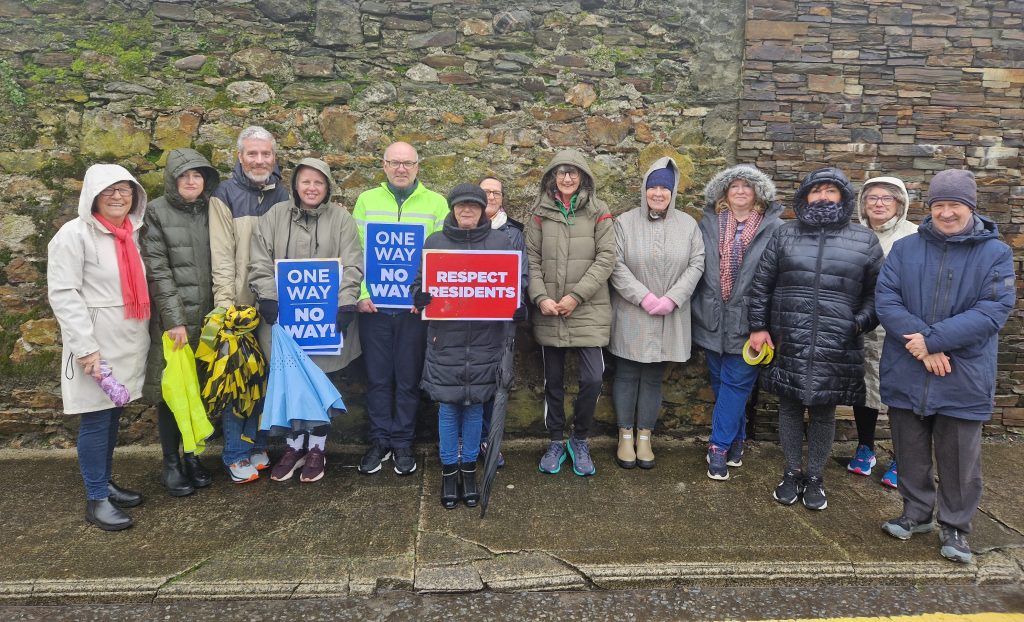
As reported earlier this month Waterford City and County Council have progressed to Phase 2 of the Newtown-Passage Road one-way system. These changes have been continuously opposed by the residents of the area, who have formed the Lower Newtown and Surrounding Areas Residents Group.
On Tuesday February 10 last, the residents decided to take action into their own hands and stage a protest outside St. John of God primary school, during pick-up time for junior and senior infants. The group held hazard tape over the footpath opposite the school, to prevent parents from parking on double yellow lines.
St John of God was the first school in the area to join the Safe Routes to School Scheme.
Only one of the eight schools in the area have been considered when these changes were being drawn up.
‘Power to the people’
During the protest children came to the windows, clearly excited, with one pupil shouting “power to the people” and making a peace sign with her fingers, to the amusement of all the adults outside.
Making a point
The residents group chose the first pick-up of the school day to make a point, rather than cause maximum disruption, although they are considering their option in terms of further action.
A spokesperson for the group explained their stance, saying: “The Council are not listening to us. It’s the same generic response”.
“It should be called the St John of God road, they started the process and they end up with a road for themselves.
“There would have been a great relationship with the schools before this. Even with the church, they called us up for a meeting in October, with that map they came up with themselves and they asked us to bring it back to the residents and we’ll talk again in a month. Then they sent it in without talking to us,” said the residents’ spokesperson.
“Fr. Power sent that in on behalf of us and we are his parishioners. They should have had the courtesy to come back to us, like they did in October.
“We had chaos before, but it wasn’t this bad.”
As with most schools at pick up times, traffic rules are not enforced and cars are often abandoned by parents who are rushing in to collect or drop off their children. The point has also been made that, with so many schools in the area, parents are coming early to get a place near residents’ homes then sitting for long periods until all their children are released from multiple schools.
The residents contend that the new one-way system has made these issues far worse, as it pushes the same volume of cars into other bottle necks and allows extra space for cars to sit outside their homes. Residents are required to pay for parking permits, although this is understood to be a small amount.
Emergency situations
The Munster Express also spoke to Thomas Brown during the protest. As well as being a Lower Newtown Area resident, Thomas is a member of the Community First Responder Group and he explained that the changes in the area’s road rules have delayed his ability to respond in emergencies.
“It affects me when a 999 call comes in. It could be chest pains, strokes, heart attack, cardiac arrest, could be bleeding. If the ambulance is delayed and I’m only 2 or 3 minutes away then we are authorised from 999,” Thomas told this newspaper.
“What’s happening now is I have to go around the blocks, which delays me from getting to the casualty.”
Thomas explained that the delay incurred by the new system could be 10 or 15 minutes, “especially in the evening times when traffic is there and calls are coming in”.
“As you know, traffic in the whole town from 3.30 pm, 4.30 pm until 6.00 pm or 7.00 pm can be very heavy,” he said.
“We’re not blue-light — nobody is allowed a blue-light other than the ambulance. I can only travel the speed of the road. But I get there as fast as I can.
“Like everything else with cardiac arrest etc — it’s all about time. Now it takes extra time to get there to that patient.
“That’s the other big fear we have in the area, when there’s heavy traffic and the schools are open and closing there is a complete blockage even for ambulances to get down here if something happens.
“Once we get the go-ahead we’ll do our best to get there,” Thomas added.
AARON KENT
Funded by the Local Democracy Reporting Scheme
