
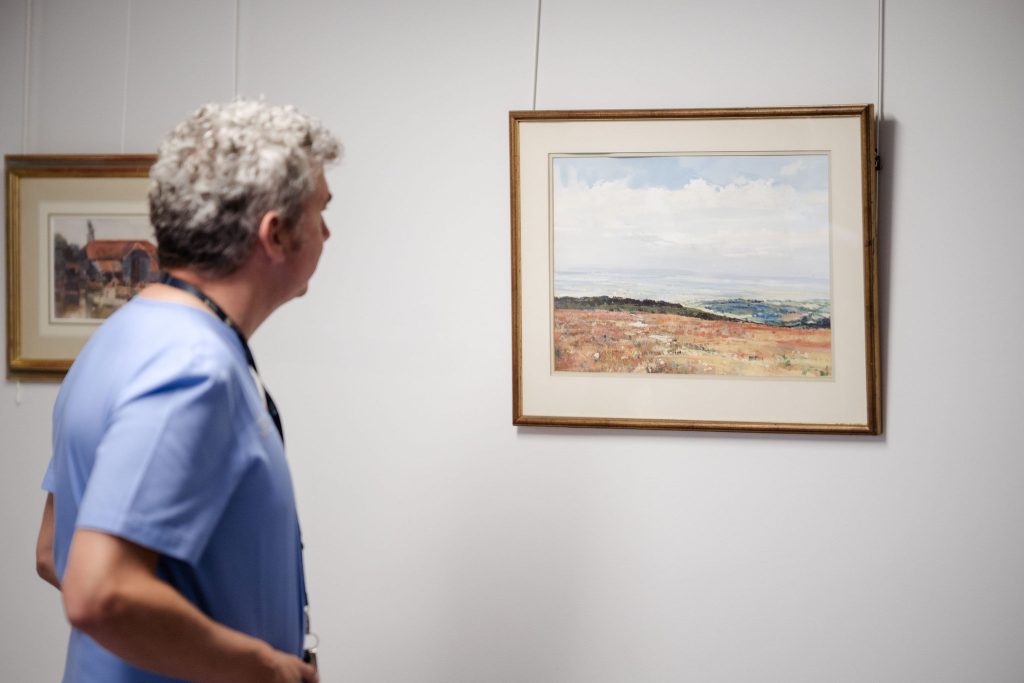
Although we’ve become accustomed to paintings and sculptures adorning hospital settings, it wasn’t always this way. Art in the healthcare environment has been normalised due to the dedicated efforts of experts, who know the benefits that art can bring, and work to share those benefits with everyone, even in what can be the most serious of settings.
The Munster Express was provided with a generous tour of the UHW art collection by Project Co-ordinator and Curator, Aisling Kennedy, with the assistance of Réalta Assistant Director Maeve Butler.
With plenty of criticism for the government and the way things are run in this country, it is easy to miss positive news stories and schemes that improve lives of those they touch.
The Per Cent for Arts scheme, first introduced in 1978, is a great example of a positive scheme as it quietly reallocates up to 1% of the cost of public developments into the commissioning of artwork.
“A percentage of funding for all capital projects goes towards art, which is great for us,” explained Aisling.
“That’s how a lot of the work actually happens in the hospital is through these Per Cent for Art schemes. It is a government initiative, and it’s a great way for us to collaborate. Even the system itself was improved recently because you have to opt out of it now. So it’s harder not to participate in the scheme.”
When asked what the purpose was behind art in hospital settings, Aisling replied,
“To make spaces more beautiful. The premise for the hospital is that we use the art works to transform the space and humanise the environment.
The hospital can feel very clinical and be quite intimidating. It can be scary for people. We find that putting art in hospital spaces humanises the space and makes them more beautiful and more welcoming.”
“Art functions in many ways. It can just be a conversation starter, a lot of the art on the walls can be conversation pieces for people sitting in a waiting area, they can help them take their mind off things.”
Aisling went on to explain that the art pieces can act as landmarks for patients and their families as they navigate the hospital, becoming central to their experience and understanding of where they are.
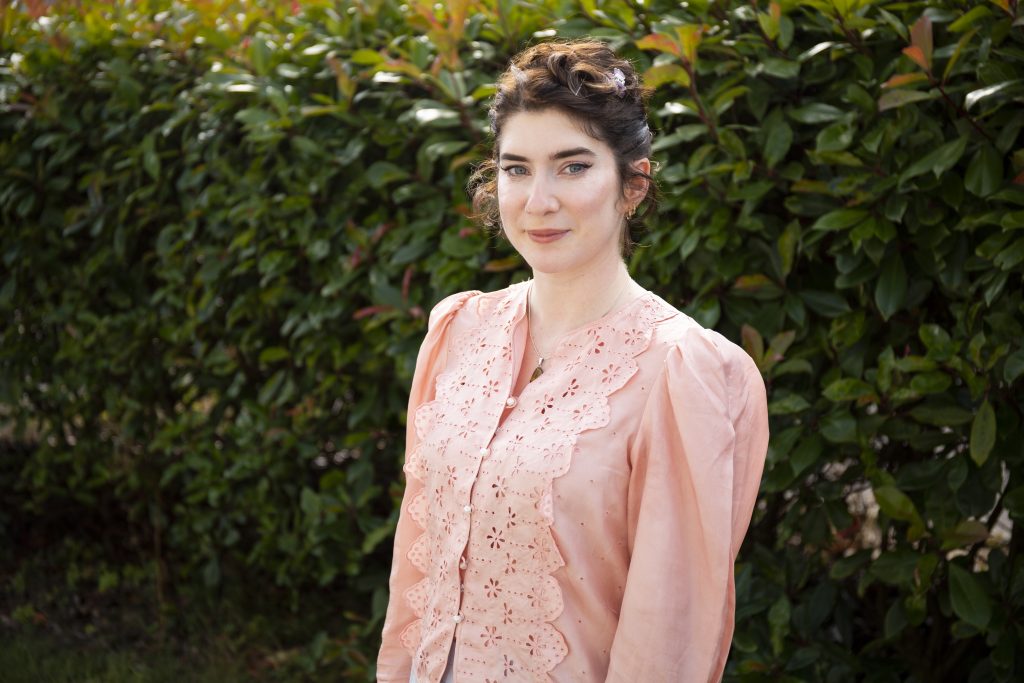
Project Coordinator and Curator, Aisling Kennedy. Photo by K. Currams
Artists on staff
UHW has a wall dedicated to art created by members of staff. On the day of visiting, the staff art wall held an impressive display of paintings from Marley Irish, who, as well as being an established artist, worked for decades as a nurse in UHW.
One of the paintings had a red dot sticker, indicating it was sold. There were multiple red dots on the full list of Marley Irish’s exhibition.
Aisling explained that there was such a demand to display work on the staff art wall that they had two year waiting list, with each artist getting eight weeks to exhibit.
“People get inspired,” she continued. “There’s a lot of photographers who like to show off their photographs and sometimes people might be inspired by a colleague, and think maybe have something to show.”
The staff refers to all professions at work in the hospital, and can include porters, health care assistants, nurses, consultants, Réalta’s own team, workers in the catering department, and everyone in between.
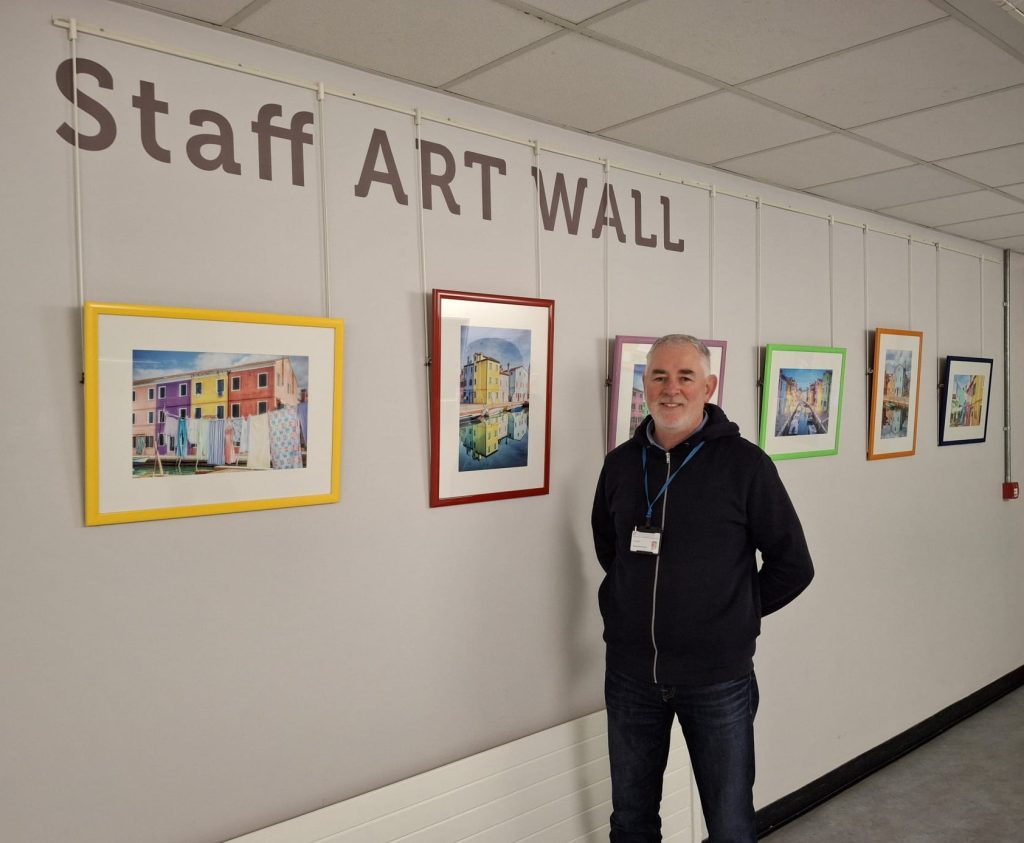
Art Installer, Tom Quilty by his exhibition ‘Burano’ on the Staff Art Wall, 2024
Programmes
In UHW, Réalta also operate art-based programmes within the hospital. A programme is a long running project and each programme is refined to suit the setting and the people involved.
“One of the things about the art collection is that we get to use it in our other programmes. We have about 16 programmes in the hospital,” explained Assistant Director, Maeve Butler.
The Open Gallery programme ran as a dementia friendly programme in 2018. The approach to dementia has changed and now it’s all about inclusion. So rather than separating and cohorting patients by their condition, we work with people all together.
“So a person with dementia is participating in the programme alongside someone who does not have dementia but may be living with another condition,” she added.
“…That works really well for someone living with dementia because they participate, and it works really well for the people who don’t have dementia because they get to see what they can still do, rather than what can’t do, which often becomes the focus.”
Meave and the team at Réalta use the UHW collection to encourage patents to respond to the art simple questions and no wrong answers.
“We devised Open Gallery based on a programme form the Museum of Modern Art in New York. It was called Meet me at MOMA. The team at MOMA had realised that many of their audience were getting older and had stopped coming to the gallery as they developed different cognitive issues, like dementia.”
It was explained that MOMA facilitated a special tour for those with dementia at a dedicated time. The Open Gallery programme takes inspiration from these tours by brining art to the wards of UHW.
“We have a fabulous art gallery, but our patients can’t get to it sometimes so we bring the gallery to the patients,” continued Maeve.
“So we bring the paintings up onto the ward. People see us wheeling paintings through the hospital and wonder what’s going on, it looks a bit mad.
“…we seat everybody in roughly speaking a semi-circle, and we have a facilitated conversation. It starts very simply, and a lot of the time people say I don’t know anything about art I can’ do this.”
Maeve explained that the participants are guided through an observation phase, which just highlights what they see, and on to an interpretation phase which might involve explaining how they understand the elements of the painting, the time of day depicted and so on.
This allows for conversation, and even disagreement, and the “most extraordinary observations and insights that we might not have seen. It’s just incredible, people constantly surprise us.”
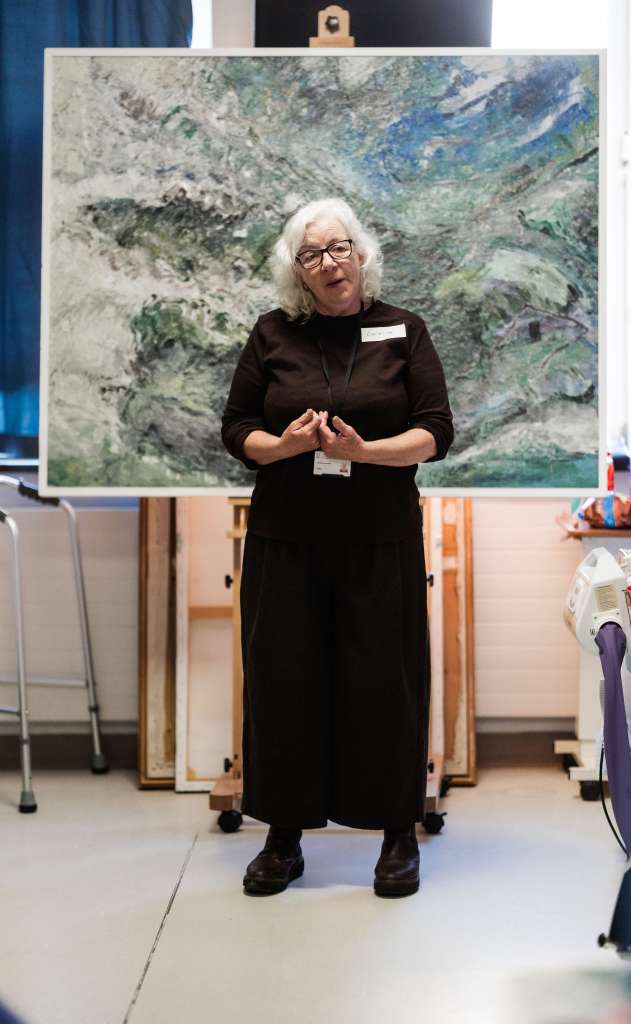
Artist Caroline Schofield using ‘Sky’ by Bernadette Kiely for Open Gallery programme at UHW. Photo by DGM Photographic
An archive
Corina Duyn is an artist with Myalgic Encephalomyeliti, a debilitating condition. Corina had no option but to enter a care home in 2022.
“She put out a call to her community email saying she was starving creatively in the nursing home, and could anyone do something to ensure she got back to her creative life,” Maeve explained. “She had been a full-time artist. She is a puppet maker and puppet designer.
“Caroline Schofield, used to go to her and visit her every Thursday in her room in the nursing home and together they developed an amazing collaborative relationship and they put together this incredible exhibition that was in GOMA for two weeks in 2023.”
Corina has entrusted the team at Réalta with her creative archive.
“She wanted to find somewhere safe that would appreciate her archive. She very kindly thought of us and donated her archive. She’s been amazing at cataloguing her life, and it’s amazing to come in and spend time with her work. She’s incredibly generous with her process, and all her notes
“There is an open invitation to anyone who would like to come and view the archive.”
The archive of Corina Duyn seems like an academic project waiting to happen, and can be viewed on appointment with Réalta.
Corina also made a short film called The Invisible Octopus, using shadow puppetry, which explains ME in a creative way. The Invisible Octopus can be found on Corina Duyn’s YouTube channel.
“In my experience it is the best creative explanation of what ME is like to experience,” said Maeve.
The tour culminated in a visit to the water birthing room, where the vibe was serene and a stained glass work acted as a skylight above the bath. How many lives have begun beneath ‘The Night Garden’ by Rayleen Clancy?
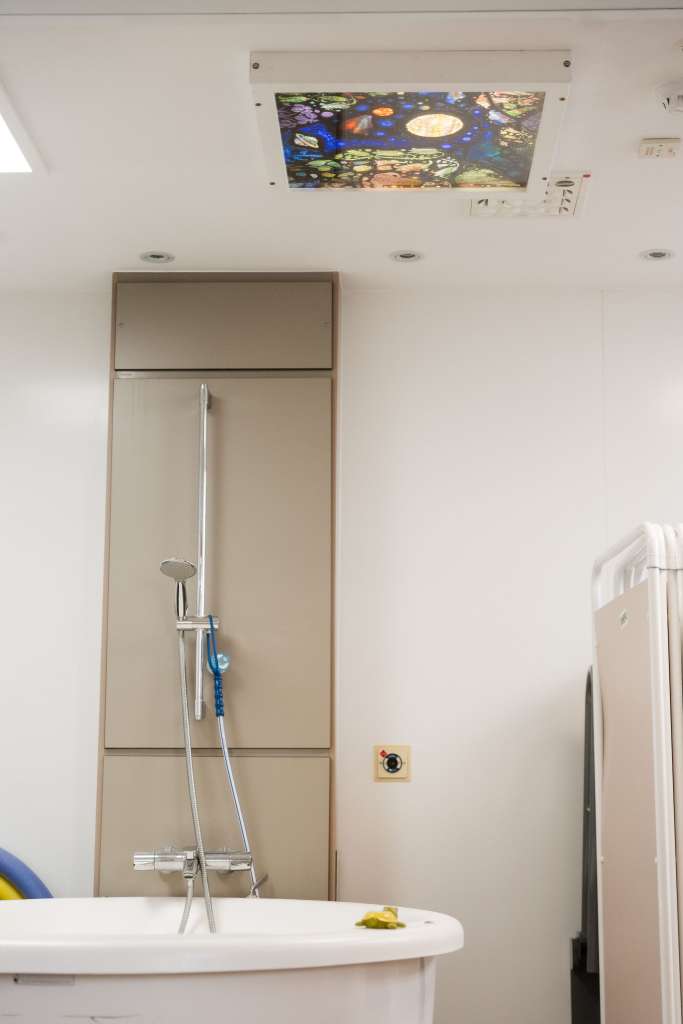
‘The Night Garden’ by Rayleen Clancy, in-situ in the birthing pool room, photo by DGM Photographic
Along with Aisling and Maeve, the core art team also includes art installers, Clare Scott and Tom Quilty and Assistant Administrator Ann Murphy.
“It is a fundamental human right to have access to the arts and that should be true even if someone is sick in hospital,” explained Aisling.
Funded by the Local Democracy Reporting Scheme

AARON KENT

