
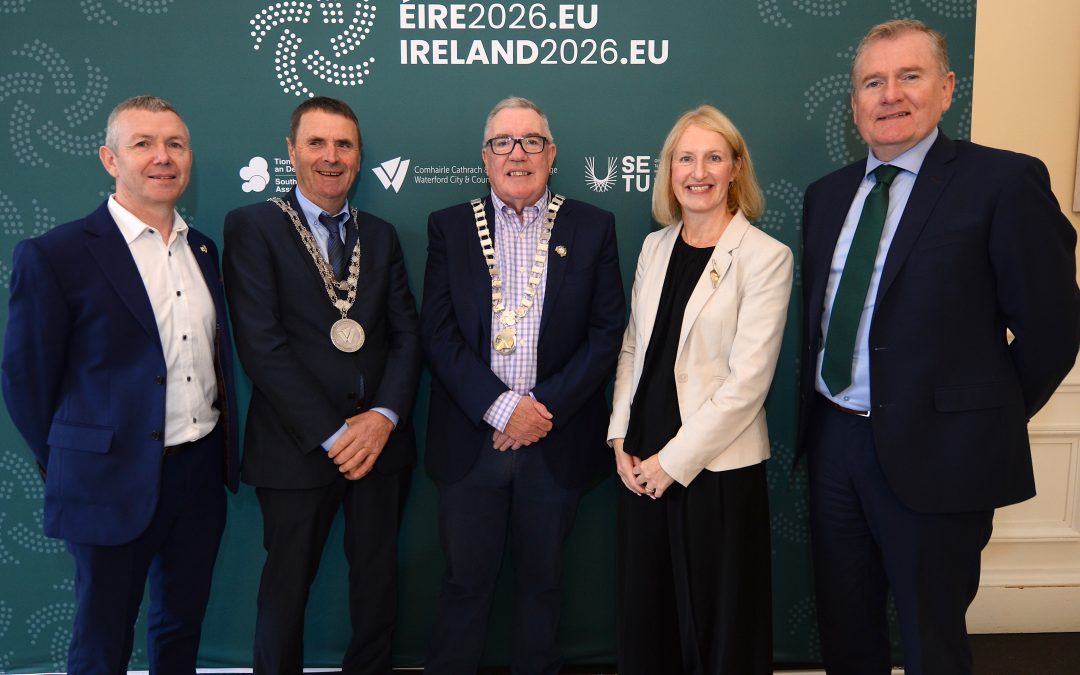
Waterford hosted an EU Presidency Associate event last week (Tuesday, 6 and Wednesday, 7 October) which explored urban regeneration within the ideas of the New European Bauhaus.
The event took place in the Theatre Royal over two days and was hosted by Southern Regional Assembly, Waterford City and County Council and South East Technological University.
The Munster Express was in attendance to hear policymakers, local authority leaders, academics, practitioners and representatives of European institutions discuss the impacts of the New European Bauhaus and the role of urban regeneration in modern life more generally.
Waterford was acknowledged as an ideal Irish venue for event as Ireland’s oldest City is recognised as a national leader in urban regeneration.
Opening the event, Mayor Liam Brazil, Waterford City and County Council, said: “Waterford has undergone significant transformation in recent years through investment in regeneration, heritage and public realm projects. We are delighted to welcome delegates to the city and showcase how place-based regeneration can strengthen communities, support economic activity and enhance quality of life.”
NEB
According to the EU policy, the New European Bauhaus “calls on all Europeans to imagine and build together a sustainable and inclusive future that is beautiful for our eyes, minds, and souls”.
It aims at transforming different sectors of economy, especially the built environment, making them contribute to our climate goals and to an improvement of the quality of life of all citizens.
“The New European Bauhaus activates different actors at different levels, from big companies to citizens’ initiatives, from national governments to city councils. It is a project of hope and perspectives that bring a cultural and creative dimension to the Green Deal- the European Climate Agenda – to enhance sustainable innovation, technology and economy.
“The initiative brings out the benefits of the environmental transition through tangible experiences at the local level.
“It gives space for creation and experimentation founded on: aesthetics, quality of experience and style, beyond functionality; sustainability, from climate goals, to circularity, zero pollution, and biodiversity; inclusion, from valuing diversity and equality for all, to securing accessibility and affordability.”
The New European Bauhaus has three core values: Beautiful, Sustainable, and Together.
“To achieve the goals of the European Green Deal and the transition towards a sustainable society, a fundamental change needs to happen on many levels. Sustainability is achievable only through collective effort by many actors. On a societal level, environmental innovations will only happen with changes in the economic framework or power relations. The technological shift needs to be supported by deeper changes that address behaviours, worldviews and paradigms. On the individual level, sustainability depends critically on compassion, empathy, unity, creativity, and the ability to shift paradigms. People will embrace or drive change when they see it.
“The quality of our living environments is essential, and art and culture play a key role in improving it. We therefore build on existing frameworks like the Davos Baukulture Quality System. The transition is just as much a cultural and a social transition as a green one: this is the key idea that the New European Bauhaus wants to explore.”
TRANSFORMATION DÉISE
Senior Architect for Waterford Council, Morris Conway has overseen much of Waterford’s urban regeneration in recent years. He addressed the crowd of experts and stakeholders at the EU Associate event, and fielded questions from the other Local Authorities seeking to replicate Waterford’s success in urban regeneration.
“The New European Bauhaus is interesting,” he said. “Because as practitioners we actually practiced a lot of the principles here in Waterford, we believe in them, and they are knitted into the DNA of our projects.
“One of the things about regeneration is understanding that it is a continuous process and an evolving process.”
Mr. Conway then referenced the famous Willem Van der Hagen landscape painting of Waterford, which shows a cluster of buildings along the quayside, and a patchwork of fields starting just beyond the area now known as the Viking Triangle.
“It’s one of the first paintings of an Irish City, it was painted about 10 years after the walls were demolished (1735-36), and it was a publicity piece from the then corporation. And what it says is that Waterford is a good place to live, a good place to do business, so come and trade with us,” Mr. Conway said.
“This city is a city in transition, with the walls coming down, and changing form a defensive city to a commercial city.
“We find [in Waterford Council] that we have a lot in common with this historic city,” he explained. “We are developing our North Quays, we have a new sustainable transport bridge, and we too are a City in transition.
“Another thing that is quite important here is that you will notice the grain of the City, and we have tried to work with the grain of the City, the fabric of the City within some of our projects.”
Mr. Morris went on to emphasise the importance of ‘reclaiming’ the City spaces, many of which were once clogged up with a relatively low volume of cars and carparks.
“John Roberts Square was our first real public realm scheme, it goes all the way back to the year 2000. It was a car park,” he added.
“There was a couple of very big moves made at this stage, we planted to enclose spaces, we put in water features, we put in seating, we also knew that there was some food and beverage outlets around there that could spill out onto the space.
“So, all of these architectural devices we followed.”
Interestingly, Mr. Morris explained the origins of Waterford’s distinctive public realm aesthetic, as seen with the grey smooth paving, and dark stone across the likes of Barronstrand Street and around Cathedral Square.
“One of the big things that Rupert [Maddock] decided when he designed this space was that he decided on a high-quality pallet of materials, so we use Kilkenny limestone, we use granite, we use bronze, stainless steel, glass, and we don’t use very much else,” explained Mr. Conway.
“Over the past 20 years we have had 12 different public realm schemes with eight different design schemes including ourselves, but what that [pallet] has meant for us is that you don’t get a patchwork quilt, because the designers have this quality material to work with, and they can apply their own feelings to it that can work within the paces.
“So, we work on 23 streets, and quite a number of spaces, but there is a consistency,” he added.
THE CRITICAL ISSUE
Also speaking on the opening day of the event, former Green Party leader Eamon Ryan said the New European Bauhaus is now entering an implementation phase. He identified housing transformation as the critical issue for democratic stability and the European Union.
“We need beauty, we need a sense of belonging, we need a sense of security, we need a sense of how we can improve our quality of life. And I think the New European Bauhaus of the last five years has been tested, been tried, has had experimental measures and now we are looking to deploy,” Mr. Ryan explained.
“I was at the festival of the New European Bauhaus a few months ago and there is a sense that we need to scale up. We’ve learnt by doing and we now need to deploy much more widely.
“Before the housing plan came out from President von der Leyen at the start of this mandate back in 2024, and recognising this is the most important, I think, issue for our democracy, for our Union,” he added.
Mr. Ryan made the point that the housing situation is fundamentally broken and suggested that rural areas also need a design transformation.
“It is the most important with our local people that they are able to set home and raise a family in the same way that my generation did, which is fundamentally broken. Not just in the cities, where it is probably at its worst pinch point, but also in rural areas, we have got this weird mix where we have prices going through the roof in certain popular cities, and then in rural areas, housing you couldn’t sell for anything.
“I think it’s important that we have that balance as we develop our villages and towns, not just about our cities. But the cities are where the tension is, and this is centre stage. Look at the Spanish election being called on the housing issue,” Mr. Ryan said.
“Look at the Berlin election, its all about housing as I understand. And it’s the same here at home. It comes and goes as part of the political cycle. But I think it’s the most fundamental one to improve the quality of life of our people.
“But it also gives a strength, resilience, and a sense of the democratic centre, not just so that it can hold, but that it can build. It is still an ongoing process, the plan rests on four pillars: increasing supply, increasing pan-European investment efforts to get the volume we need, looking at state aid rules and changing support systems be that planning or tax, and also particularly looking after the most vulnerable, getting our student accommodation, and if we can address homelessness, housing first sort of thinking, then by definition we will have the right supply,” Mr Ryan added.
As his contribution went on, Mr. Ryan argued that housing cost is far more than a financial measure.
“Our housing advisory board in the report we wrote for the commission, just in advance of the affordable plan and designed to influence it, was very strong with the view that it isn’t just about numbers, it isn’t just about shooting up supply, we also have to think about quality,” he said.
“And that fundamentally, the cost of living crisis that we are in, the cost of housing crisis that we are in some of the cities and towns across our union. It is important that you define what the cost of a measure is, yes, it’s rent and yes, it’s purchase price, but it’s not just that. You have to look at the running costs, the fuelling costs, you have to look at the time costs.
“If you put everyone into housing that involves a one or two hour commute each day there and back, that’s incredibly expensive in terms of people’s lives. And it’s similar in terms of health measures.
“The benefits of getting good urban design with a good local environment with clean air, quiet streets, with healthy transport systems, encouraging people to walk, is really important,” Mr. Ryan added.
AARON KENT
Funded by the Local Democracy Reporting Scheme
