
AARON KENT
EirGrid, the group responsible for developing, managing and operating Ireland’s electricity grid gave a presentation to Waterford Council at the January Plenary meeting.
EirGrid describe their job as being: “We are responsible for the safe, secure and reliable supply of Ireland’s electricity. Our job is to bring power from where it is generated to where it is needed throughout Ireland, onshore and offshore.
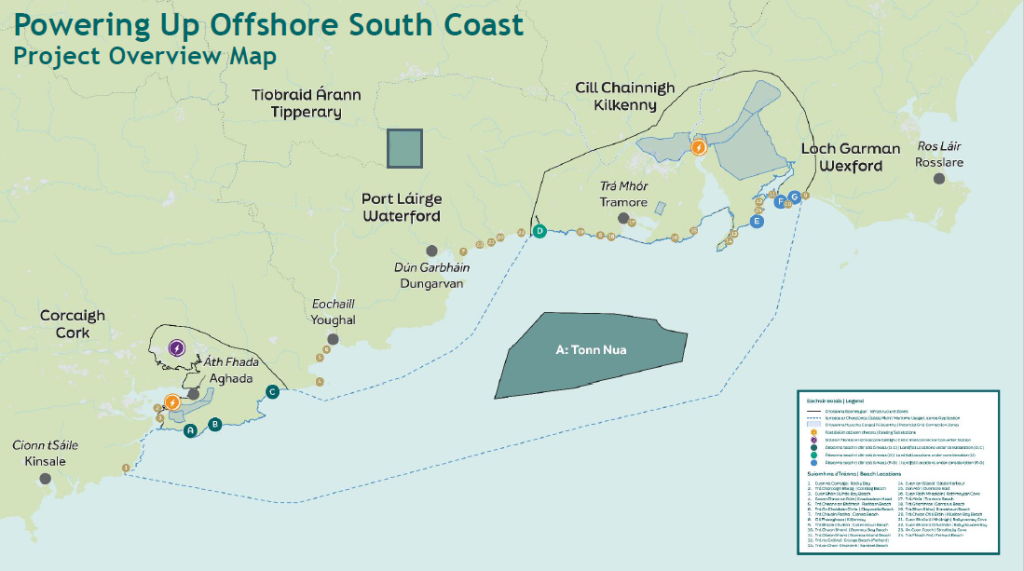
The presentation given in Waterford Council chamber, concern the off shore side of this work, as the EirGrid team outlined their Powering Up Offshore – South Coast Project, which intends to build a new transmission grid to bring power generated by Off shore Windfarms off the South Coast into the national grid.
This particular project concerns an area that will be developed into a windfarm off the coast of Waterford, in a sea area known as Tonn Nua. The development will consist of two off shore substation platforms.
The project team say it will help deliver approximately 900 megawatts of additional electricity, which is enough to power almost one million homes.
During the presentation, the EirGrid team explained that 900 megawatts was too much for any one substation to process, so 50% would go to Cork and the other 50% would go to the Waterford/Wexford area.
The location where the electricity will connect to the grid is Great Island power station in Wexford, opposite Cheekpoint.
This proved an area of contention for Councillors, as Blaise Hannigan commented,
“From my own point of view Waterford is getting nothing from this.
“You have a connection site in Cork, you have a connection site in Wexford, so I see no benefit…I am in favour of windfarms but I don’t see benefit to my town, my county, my city.
Likewise, Fine Gael’s Pat Nugent said Waterford was being dealt a bad hand of cards in the development.
“What is in it for Waterford?”
“…I just think we’re being dealt a bad hand of cards. Waterford people will be looking at these turbines out in the sea, but the benefits will be going to Wexford and Cork.”
Sinn Féin Councillor, Catherine Burke, also raised concern as a resident of Bunmahon village.
“As a resident in the village of Bunmahon, this is extremely important to me and my neighbours around me.
“Most people agree that renewable energy is an idea, however the distance from shore is a concern to the people living on the coast. People living in rural West Waterford are dealing with applications for data centres, applications for solar farms, and also this application for a wind farm.”
“You mentioned particularly the village of Bunmahon here today,” she continued. “What effect is this going to have on such a village if that’s the chosen [landfall] point?”
“This is a village that is suffering from basic lack of infrastructure, like waste water infrastructure. We cant seem to get the sewage treatment plant into the village.
“We were also denied our costal cliff walk by An Bord Pleanála, and the reason for that is a special area of conservation…what special arrangements are you making for that special area of conservation?”
In response to these concerns, the EirGrid team, said “It has to connect to infrastructure on the grid, and that [location] is Great Island, that isn’t going to change.”
The team also explained the wind farm will strengthen the grid which will benefit the whole of the region, and that the construction phase should bring work and economic opportunities to local businesses.
While Bunmahon is a potential site of the landfall location, the team said it was not one of the favoured sites at present, given its distance from Great Island.
With Councillors from the West of Waterford feeling their region is being targeted for solar farm developments, and as much of their best, food-producing, land may soon be hidden under solar panels, Cllr. Seanie Power asked how much would one wind turbine produce compared to an acre of land?
To this the team replied, “roughly one turbine would equal 75 acres [of solar panels].”
The EirGird team are hopeful that construction will begin in 2030 and be completed in 2033.
AARON KENT
Funded by the Local Democracy Reporting Scheme
