
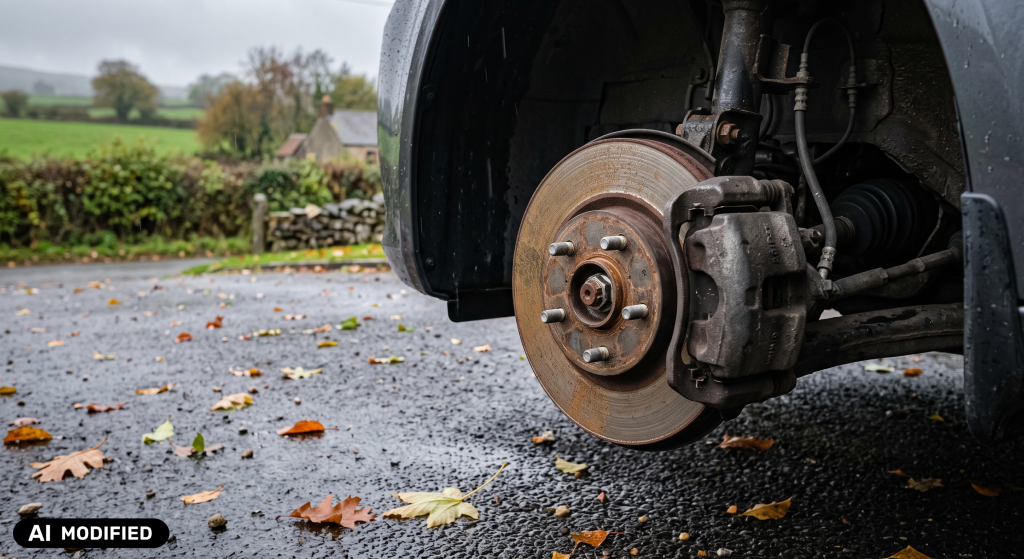
Autumn maintenance often focuses on tyres, lighting and visibility, but damp conditions also make it useful to pay attention to exposed brake components. In Munster’s persistently humid climate, brake discs are particularly relevant, since their friction surfaces are directly exposed to moisture with no housing or seal to keep the weather off.
Why damp conditions cause surface rust on brake discs
The mechanism involved is straightforward. Cast-iron disc surfaces oxidise on contact with atmospheric moisture, which is why a vehicle left overnight, particularly after a wet day, often shows a thin film of surface rust the following morning. Under normal driving conditions, this layer is removed within the first few brake applications.
Damp conditions do not, on their own, cause discs to fail. What they do is give surface rust more opportunity to develop between uses. Vehicles used mainly for short journeys, or left parked for longer periods, can allow this surface oxidation to persist rather than being worn away as it normally would.
Why Munster’s climate makes the issue particularly visible
Munster’s reputation for wet weather is supported by observational data. Met Éireann’s Annual Climate Statement for 2025 recorded 1,809.4mm of rainfall at Valentia Observatory in Co. Kerry, one of the province’s long-established weather stations, representing 110% of the station’s long-term average. This single data point illustrates the kind of sustained damp conditions parts of Munster experience, rather than establishing that the whole province is uniformly wetter than the rest of the country.
When surface rust becomes a reason for inspection
A thin, even film of rust after a vehicle has been parked overnight is normal and typically clears after light braking. The distinction worth attending to is between this temporary film and rust that persists, thickens or becomes pitted on the disc face, which indicates a different condition and should be assessed by a technician.
The relevant reference point is the manufacturer’s specified minimum thickness for the disc, usually stamped on the disc itself. A technician can measure a disc against this figure; surface appearance alone is not a reliable way to judge whether a disc remains fit for use. Brake performance is also one of the areas assessed during Ireland’s NCT, which is a further reason uneven wear or persistent corrosion is worth identifying during routine maintenance rather than at test time.
What signs can point to a brake disc problem
● Persistent or pitted corrosion. Rust that does not clear with normal driving, or that has visibly pitted the disc surface, is a sign worth having checked rather than left to resolve on its own.
● Pedal or steering wheel pulsation. A rhythmic vibration felt during braking, particularly at higher speeds, can be associated with disc thickness variation or lateral runout, although the specific cause should be confirmed during inspection rather than assumed.
● Visible damage. Deep grooves, cracks or a disc that has changed colour due to heat are signs that warrant assessment.
● Measured wear. A thickness reading at or approaching the manufacturer’s minimum indicates the disc is nearing the end of its usable life, regardless of how it looks.
Squealing or grinding noises are also commonly reported alongside brake wear, though these are more often associated with the brake pads than with the disc itself and do not on their own indicate a disc-specific fault.
When brake discs need replacing
Where an inspection confirms that a disc is corroded beyond a surface layer, measured below the manufacturer’s minimum thickness, or otherwise unfit for continued use, replacement depends on fitting a part that matches the vehicle. Compatible brake discs can be compared on the AUTODOC website once an inspection has established that replacement, rather than continued use, is the appropriate outcome.
For drivers in Munster, a light film of rust after a damp night is not unusual. The reason for inspection is when corrosion persists, braking behaviour changes, or measured disc wear approaches the manufacturer’s limit.
Brake discs can be compared on the AUTODOC website
Sponsored Content
