
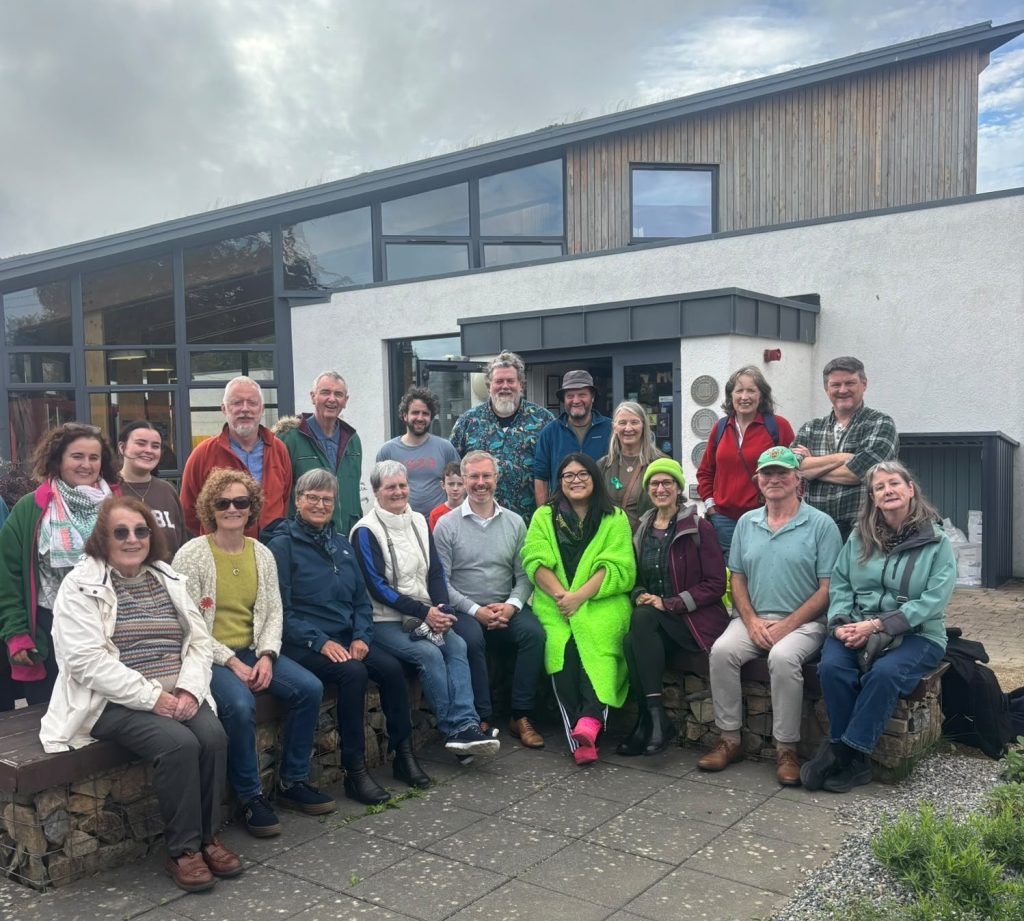
Green Party leader Roderic O’Gorman visited Waterford over the weekend for a think-in style event, to meet with Green Party members, and visit some environmentally-aligned projects in the East of the county.
The Munster Express caught up with Deputy O’Gorman to get his views on rebuilding the Waterford Greens, carbon tax at a time of fuel crisis, data centres and the huge renewable energy projects in Waterford.
Waterford has had some big characters in the Green Party through the years. Is there a Green Party vision for Waterford going forward?
“Absolutely. I am here to meet with the Waterford Greens today. As you say Waterford Greens have a very proud history of representation on the City and County Council, in the Dáil with Mark [Ó Cathasaigh] and of course in the European Parliament with Grace [O’Sullivan],” Deputy O’Gorman told The Munster Express.
“We as a party now are very much focussed on the Local Elections in 2029. We’ve had a good year in elections here in 2026. The bye-election in Dublin Central went well for us, we came third there. We beat Fianna Fáil, we beat Fine Gael, we beat the Monk. We have a real chance of taking back a Dáil seat there.
“What I have been doing over the summer is going around the country meeting with our local Green Party groups and talking to them about the elections in 2029, and where in their local area they see the opportunities for the Greens to retake seats, and that’s the conversation I will be having with my colleagues in the Waterford Green Party.
“I would see taking back seats in the City and County Council in Waterford as an absolute priority. We’ve held two here in the past, and we’ll be looking to take seats back,” said Deputy O’Gorman.
“I started my political journey in local authority, I know it’s importance. Particularly with an amalgamated City and County Council like you have here in Waterford. Making sure that the public transport measures put in place in the City are delivered, making sure the housing that was meant to follow that actually follows through. Having strong Green voices at local authority level are really important there.”
In terms of winning back seats, is Carbon Tax a hard sell when fuel is already so expensive?
“The reason fuel is expensive right now isn’t the carbon tax. The reason fuel is expensive is because we are massively dependant on oil and gas and their prices have been spiked by a global war, the war in Iran,” Deputy O’Gorman replied.
“The carbon tax is the only part of our taxation system where the money that comes in is ring-fenced and is used directly to help us break free from that dependence on fossil fuels. If the government interfere on the carbon tax this year it will mean fewer houses get retrofitted next year, it will mean fewer people get low cost solar panels on their homes. It will mean people are left more vulnerable to the next spike in energy crisis.
“In the last two years we’ve had two cost of living crisis’s, both of them have been solely driven by the cost of oil and gas. The war in Ukraine driving the first, the war in Iran driving the second. Other European countries after the Ukraine war changed the makeup of their energy system, they leaned into renewables. We haven’t gone far enough here in Ireland to do that yet, both at a national level and particularly in terms of what we can do for each household in the country so we can make sure that they can have solar panels, so they can have free energy half the year, and they have the battery to store it, that they have a retro fit so they are not wasting so much heat in the winter.
“Those are the steps. There is a cost to those steps absolutely. What frustrates me over this summer is that the government have spent €1.3 billion on short-term excise cuts [reductions in fuel tax after the fuel protests] which are done and the benefit is gone, whereas if they were spending money of that scale in terms of retrofitting homes in terms of giving really low-cost solar panels, those benefits are not short-term, they are long-term and would protect families into the future.”
My understanding of Green Party policy is to give people back a dividend from the carbon tax, and older people would get more back than younger people.
“Carbon tax that comes in would be spent in three ways. It’s spent on retrofitting homes both for middle class families but also totally free retrofits for people from disadvantages background,” Deputy O’Gorman said.
“Some goes to the Winter Fuel Allowance, the social protection, and the reason that has been able to increase in recent years is because directly the carbon tax income goes to that and it goes back to people.
“The third thing is a scheme called Acres, a scheme for farmers who are farming in an environmentally friendly way. That’s how it’s spent at the moment and all the money that comes in goes back out across these areas.”
Younger people who are already struggling with the cost of living and can’t get a house won’t benefit from that. They will pay more for their fuel and they won’t get the dividends?
“First of all, we have to ramp up the roll out of the retrofit, we have to make sure that more people’s homes are retrofitted,” Deputy O’Gorman said.
“Secondly there are other things that the government should do or shouldn’t do, I see the increase in public transport fares that the government is allowing happening, that’s something the government shouldn’t be doing. Personally, I don’t think they should be doing it at any time.
“We need to make public transport affordable and more people will take it. We saw that over the last four years. But in the very middle of the cost of living crisis, that we all acknowledge that the government are putting on average 15% on people’s public transport fares and some fares it’s going up by 33%, and the young people you have just referenced there they will in particular be hit by this hike in prices.
“That’s a political choice by Fianna Fáil and Fine Gael. The Greens are leading the opposition to the public transport fares increase, we’ll be having a demonstration outside the Dáil next Thursday. And if the government take €85 million this budget and give it to the National Transport Authority these fare hikes don’t have to take place.”
Waterford has been disproportionately selected for data centre, solar and wind farm developments. There’s a worry locally that this is not a green agenda but is industrialising Waterford’s green spaces, regardless of how many objections are made. How does the Green Party view the situation?
“Well data centres aren’t the green agenda. I’ve real concerns about data centres. I think we need an energy system that gives households affordable energy, that gives the country energy security so we are not dependant on Trump’s LNG or Putin’s gas, and that decarbonises as well,” replied Deputy O’Gorman.
“Data centres are undoing all three of those, data centres are adding to the amount that each person pays on their bills.
“Friends of the Earth put out research that shows Data Centres have added €360 to everybody’s bills on average. Data centres are now taking 23% of electricity in the country. That’s totally out of line with what’s happening with any other country in the world. They are not giving us energy security either and they are now starting to eat up the renewable energy that is coming online so they are not decarbonising either.
“So, the Green Party position on data centres is there should be a pause on new ones being constructed. When our energy grid is bigger, when really cheap off-shore wind is coming on and we have more energy in the country—yeah, five or seven years’ time maybe we can look at more data centres then, but now there should be a pause. And existing data centres should pay a levy to allow us to pay less on our bills.
“I don’t see them as part of the Green agenda and while we are building wind farms, while we are building solar, they should be about getting us to use less gas and therefore bringing down the wholesale cost of electricity for everyone. But too often now they are being linked to data centres and the data centres are being built and this good renewable cheap energy isn’t going to make mine or your bill more affordable, it is just going into the data centres.
“I share a real concern about the proliferation of data centres. It’s an issue here in Waterford, it’s an issue in my own constituency where there are about twenty. It’s a real issue in many parts of the country,” Deputy O’Gorman added.
AARON KENT
Funded by the Local Democracy Reporting Scheme
