
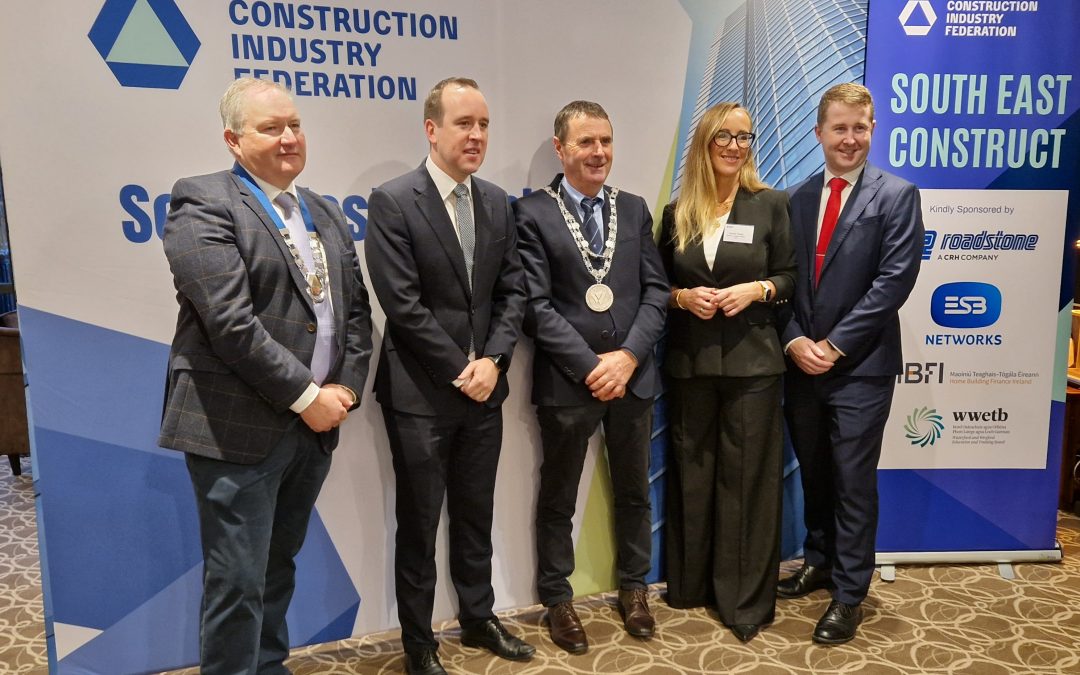
On Friday, October 16, the Construction Industry Federation held the Construct 2026 Conference, where construction industry leaders and state bodies came together to connect and explore the challenges and opportunities ahead for the construction industry in the South East.
It was an early start for all involved as registration opened at 7.00am. There was an industry presence in the entrance area with a number of tables from national companies and public bodies like Uisce Eireann, ESB, and Home Financing Ireland.
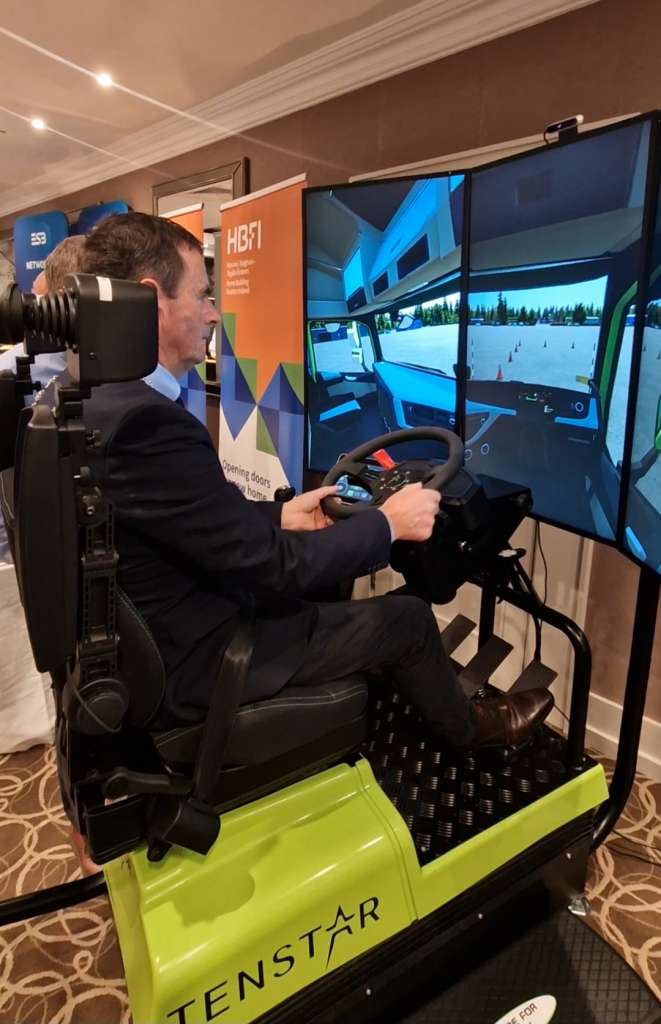
Waterford and Wexford Education and Training Board brought the tech with a virtual reality exercise installing a window and a three-screen lorry driving simulator.
The event was hosted by Joanne Treacy, CIF Director for Southern Region Services. Chairman of the CIF South East branch, Tom O’Brien opened the event, saying, “across Waterford, Wexford, Tipperary, and the wider South East region, there has been momentum. Major regeneration projects are reshaping our urban centres, a growing university is driving skills, research and innovation.
“Strategic infrastructure from transport to energy is moving through planning and into delivery. We have a construction sector that continues to demonstrate resilience, adaptability and ambition. Of course more work is required to ensure that our ambitions are fully met.”
Acknowledging the change in the construction landscape in recent years, he said, “The South East is no loner a region waiting for investment, rather it is a region competing for and winning it, and of course our challenge is to try and deliver it.
“To sustain that momentum we need alignment within the industry, government, education and Local Authorities. We need predictable pipelines, modernised procurement, accelerated planning and continued investment in skills. We need to keep talking to each other, openly, constructively and with a shared sense of responsibility for the future of this region.
“Our industry builds more than infrastructure, we build communities, we build opportunity, and we build the foundations of regional growth. The South East has enormous potential, but potential only becomes reality when people come together with ambition and clarity.
“Hopefully this morning can add to that.”
EU LEADER
Minister of State for planning TD John Cummins, began his keynote speech by acknowledging the ‘terrible tragedy’ that had happened in Waterford earlier that week, when 4 members of the English family lost their lives due to an arson attack. He said it was a ‘heinous crime’ and sent thoughts and prayers to the family and wider community.
Speaking about the Construct 2026 conference, he said, “this is a really good opportunity to come together and talk about the challenges and opportunities within the construction sector here in the South East, and right across the Country. We all know that housing delivery is the number one issue facing the country.”
“As Tom [O’Brien] said the delivery of homes at pace and at scale is a challenge that each of you in this room face on a daily basis. From my perspective, I see my job as being one which supports all of you to build on the momentum that has been generated over the last number of years. By working together I am absolutely confident that we can drive the construction centre in the South East and nationally forward.
“As a government we are committed to tackling the toughest problems head on…”
TD Cummins also took the opportunity to push back against the opposition narrative that the government is failing to tackle the housing crisis.
“Although I am biased I do believe we have demonstrated as government a willingness to listen to the construction sector, and in the spirit of collaboration, made significant changes which are visible on the ground,” he explained.
“Although you would never think it, from listening to commentary or the opposition, Ireland now has the fastest rate of homebuilding in Europe. Twice the EU average and three times that of the UK. All of the metrics are positive, planning permissions are up, commencements are up, completions are up, and I do believe that by the end of the year our output number will start with the number 4.
“An important metric of progress is also the number of new homes going to first time buyers, which is also up and continuing to increase due to a range of supports that have been introduced by government, and which will continue to maintain in the face of opposition.
“These metrics didn’t happen by accident,” he continued. “They happened due to the sustained effort of each of you in this room. Working in collaboration with government. A new era of social house building is upon us. In 2025 alone a total of 9,085 new homes were constructed.
“This is the highest delivery on record.
The South East counties have seen almost 12,000 social homes delivered across all delivery programmes since 2020, and everyone in this room should be rightly proud of that achievement, although we cannot rest on our laurels.”
HEALTH IS WEALTH
Another notable presence at the conference came from the Construction Workers Health Trust, who highlighted the extensive supports available to help improve the health of workers in the construction industry.
The CWHT formed in 1994 and is dedicated solely to improving the health among construction workers. It receives no state funding, does no fundraising, but is funded entirely by a voluntary €1 weekly contribution by workers who are members of the Construction Workers Pension Scheme.
It was explained that 8 people had lost their lives in the construction industry in Ireland this year, compared with 11 from this time last year. Speaking at Construct 2026, Dr. Alison Gilliland, Executive Director, Construction Workers Health Trust explained the role of the organisation,
“Part of what we do is from the belief that by keeping workers healthy we are keeping them safe on site…we have our own team of nurses around the country. Our prime work is going out on site and giving workers half an hour one-on-one with the nurse to get the health screening done.”
Dr. Gilliland also advised that the CWHT conduct research and awareness campaigns, recently a significant effort brought attention to the use of energy drinks on-site. Energy drinks, combined with intense physical labour can strain the heart and dehydrate those who use them.
“The 30 minute health screen is very much back to basics” she explained. “It’s blood pressure, it’s height, weight, body mass index, lung check, fingerpick, cholesterol, diabetes—so no big needles and no need to fast.
“The results are absolutely immediate, and the nurse will discuss the results with the workers so they leave knowing what their health level is for that particular moment in time.”
Using a QR code, CWHT, allow workers to fill all their health details into an app, to give a complete view of their health situation and track their progress going forward.
“It allows them to log subsequent health data, integrate their wearables, and every Friday we publish an article to the app. The idea is we are encouraging workers to become more involved in their health and keep all their health information in one app that is safe, secure, and on their mobile phone.”
Dr. Gilliland shared the shocking statistic that 8 out of 10 construction workers they screened had abnormal blood pressure.
“We found from the data we collate anonymously, 80% of the workers we screen do not have normal blood pressure. Hypertension, high blood pressure, is a silent killer. You feel well, no symptoms, the first symptom you might get is a heart attack. We have sent workers sadly to A&E, some of them had stents put in that evening, their blood pressure was that high and their hearts were that damaged.”
“So it very much is preventable. It is trying to make workers aware that their health is important it helps them keep safe.”
AARON KENT
Funded by the Local Democracy Reporting Scheme
