
Earlier this year it was reported that there are only 25 plastering apprentices in all of Ireland. This news comes as part of a general shortage in what are known as ‘wet trades’ like plastering, block laying and tiling.
Government have also acknowledged a ‘critical lack’ in mid-career professionals in these areas, which would be those with 5-10 years of experience.
In 2006 there were over 13,000 plasterers in Ireland, by 2022 this had fallen to over 5,000, with many of these workers nearing retirement.
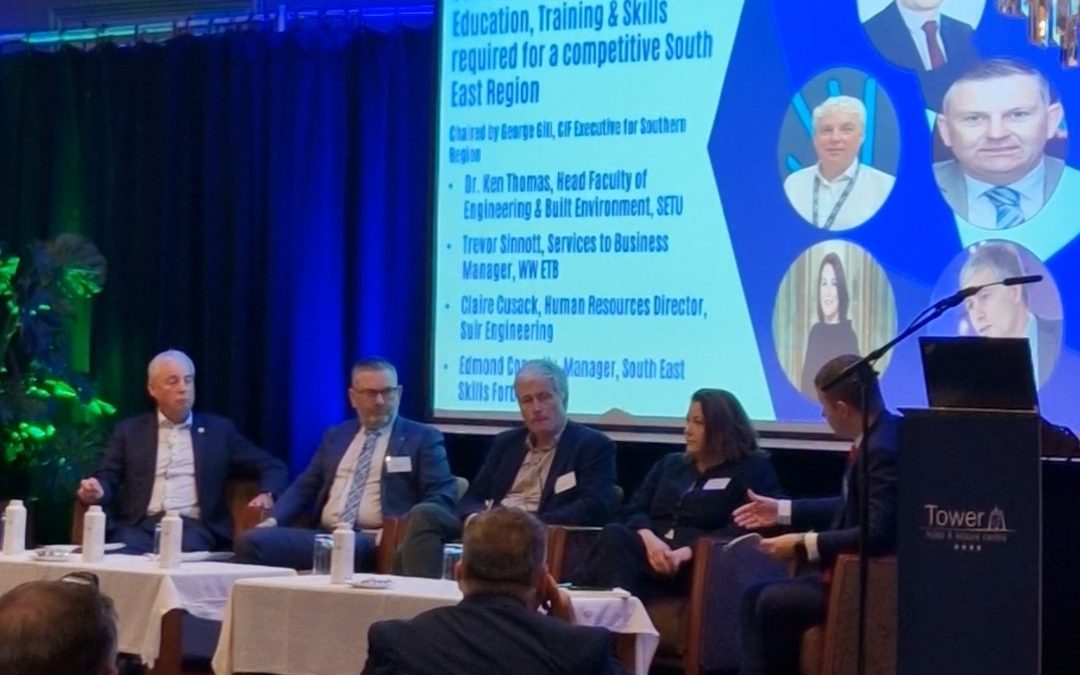
This crisis was discussed at the latest Construction Industry Federation Conference, Construct 2026, where it was explained that Waterford has become the only location in Ireland to service Phase 2 of the plastering apprenticeship.
Speaking on the Education and Skills panel of Construct 2026, Edmond Connolly, from the South East Skills Forum, said the messaging around certain careers will need to modernise.
“There’s no point in builders saying we haven’t enough plasterers, we haven’t enough block layers, we haConstructven’t enough whatever without engaging [with education providers] and pushing the buttons,” said Mr. Connolly.
“I’m in the middle of education and enterprise, and the education partners are excellent at designing courses, they are excellent at delivering courses, but they can’t be inspired to fill the seats. So, there are a number of things you have to do, including really positive messaging about the careers.”
€70,000 A YEAR
One number that jumped out from the discussion was the salary that a relatively new plasterer could expect to earn after they completed their apprenticeship.
“We did a study in the south east about the plastering trade, and the plastering trade has diminished dramatically,” said Mr. Connolly. “The only place in Ireland you can do plastering Phase 2 is here in Waterford. So, if you’re from Donegal and you want to be a plasterer, you have to come to Waterford for you Phase 2. There’s only about 30 registrations a year, but we’re trying to grow that.
“I was asked what could a plasterer earn, and I said after about two years’ experience having qualified, I said about €70,000, and the person who asked me couldn’t believe it. I think you should follow the money as well, people can knock a great living out of construction, there are so many avenues into it. We need to advocate and tell the story about that,” added Mr Connolly.
STUDY
Earlier this year, South East Regional Skills Forum, published a study into plastering trade, using the south east as the central case study.
Four recommendations emerged from the review including, promotion, shortening the apprenticeship, upskilling for school leavers and new entrants, programmes like try a trade for transition year, and enabling broader access around the country. The full recommendations are:
- Promotion: Develop & Implement a promotional campaign for the plastering trade. The National Apprenticeship Office (NAO) in partnership with the Construction Industry Federation to create appropriate promotional material for the plastering trade. This should include career videos and other useful marketing collateral targeted at school leavers.
- Shortening: Plastering Apprentices who complete the mandatory duration for each of the seven phases of their apprenticeship should be deemed to have completed their apprenticeship once they have served a minimum of 156 weeks (three years). This would considerably shorten the apprenticeship from the current minimum duration of 208 weeks (4 years).
- Upskilling: Education & Training boards (ETBs) in the South East to scope out a ‘Plastering Introduction Course’ to cover ‘Lining Systems and Render Finishes’ for school leavers & new entrants to include an introduction to plastering, building learners’ competency with hand skills and basic understanding of plastering. Also include driving skills to obtain a driving license, soft skills including communications and a short period of work experience with an employer. Seek exemption from Phase 1 of the apprenticeships for those who successfully complete this course. Pilot this course in up to three locations. Monitor the results and if successful, expand further.
- Transition Year: The Gyproc Ireland programme for Transition Year students ‘Try the Trade’ for plastering should be offered in a number of locations across the South East region initially. SERSF and ETBs to pursue.
- Enabling access: SOLAS / NAO to plan for an expansion of plastering apprenticeship locations in Ireland – explore co-location with National Centres of NZEB Excellence & elsewhere, in line with demand.
WOMEN AT WORK
It was mentioned repeatedly throughout the panel discussion that there is a pressing need to get more women to work in construction.
This is not just for reasons like social inclusion, but also for the practical reason of expanding the available pool of skills that the construction industry can draw from. Limiting potential workers to men, or mostly men, means that half to talent in the general population will inevitably go and develop their skills in other industries.
Engineering was highlighted as one area of huge demand across the construction spectrum.
“The one area where supply and demand is completely out of demand is engineering skills,” explained Mr. Connolly. “Because construction is looking for engineering skills, utilities is looking for engineering skills … and when I say engineering, that’s everything from metal fabrication through to electrical apprentices, plumbing, through to automation, the full spectrum.
“That’s where the huge demand is, and it’s not only for construction. I don’t go into schools, but if I was to go into schools, the one message I would put out is the fear about AI taking jobs, but those technical disciplines, engineering-related construction and manufacturing, I don’t think they are going to go out of favour anytime soon, and whether you start off as an electrician or do quantity surveying or welding, it is a wonderful start, and there’s great opportunities to progress. But we still haven’t enough people,” he said.
According to Mr Connolly, there was a clear area that should be tapped for unfulfilled potential.
“It’s complicated by the fact that broadly speaking 50% of the population turn their back on engineering. It’s male dominated, we haven’t the women coming into engineering,” he explained.
“Females make some of the best electricians, but we are still in the low numbers. The careers that are there are tremendous. They are almost more exciting than any other area because a lot of the construction projects are transitioning to low carbon, or green energy, and these are really important and impactful things you are trying to achieve, and this resonates with young people. We need to promote it to both genders.
“There are a lot of young people that are ideally suited and would flourish in construction, but are not seeing these stories. We need to do more on that,” Mr. Connolly added.
Later in the discussion, Services to Business Manager for WWETB, Trevor Sinnott, explained that there is currently an incentive unique to Waterford and Wexford in the form of a Craft Apprenticeship Female Scholarship.
“Uniquely enough to Waterford and Wexford ETB, we did develop a craft female scholarship, where an individual can avail of €4,000 if they have been educated in out region, and that’s unique to the country, there is not another one,” Mr. Sinnott said.
This scholarship covers a wide range of trades including farriering, toolmaking, brick and stone laying. Full details can be found on the WWETB website.
AARON KENT
Funded by the Local Democracy Reporting Scheme
