

The number of fraud-related offences reported to Gardaí in Waterford-Kilkenny has, on average increased over the past two years, but Gardaí are doing all they can to combat these scams, as officers in Waterford were recently involved in a Europe-wide operation that recovered over €2 million in Bitcoin.
According to figures from the Central Statistics Office (CSO), there was an almost 9% increase in the number of these offences reported to Gardaí in the south-east between 2024 and 2025.
The Munster Express spoke to Garda Superintendent Gavin Hegarty, who highlighted the different types of fraud scams that are occurring at the moment, and offered advice for members of the public on how to remain vigilant.
The Garda website defines fraud as something that occurs when “an individual deceives another by inducing them to do something or not do something that results in a financial loss.” These types of fraud offences can be committed either online, in person or via correspondence.
Speaking at a quarterly meeting of Waterford Local Community Safety Partnership (WLCSP), held in Dungarvan on Monday, 7 September, Superintendent Gavin Hegarty provided updates on recent crime figures and explained how Waterford Gardaí investigate frauds. He also provided advice for the public on how to avoid falling victim to scams.
At the meeting, Supt. Hegarty said that an average of 150 and 200 fraud-related offences are reported to Waterford Gardaí every quarter, with some of these being reported retrospectively rather than necessarily occurring during the time period they are reported.
Supt. Hegarty explained how fraud-related offences can be reported to An Garda Síochána. “[With] financial institutions, the obligation is always on the institution, that when they become aware of a fraud, part-fraud, or an attempted takeover of somebody’s account that they’re obliged to report it to An Garda Síochána – so that can take some time to happen. It can happen without the person who was the victim at that point ever knowing that it has happened,” the Superintendent said.
“They may have got their money back, but that crime still counts, and it gets reported to An Garda Síochána. At the moment, we have one or two financial institutions where it’s currently two years post the event, but that still has to be investigated by us,” he said.
“So, myself and Larry, [Superintendent Sheahan, Dungarvan Garda Station] both have teams of people who are literally, all they’re doing is investigating online frauds, and the retrospective online frauds, and it’s taking a massive amount of time and resources.
“In the vast majority of cases, we find that the money has gone out of the State, and that proves extra difficult trying to bring resolution to that for the victim and trying to get the money back.”
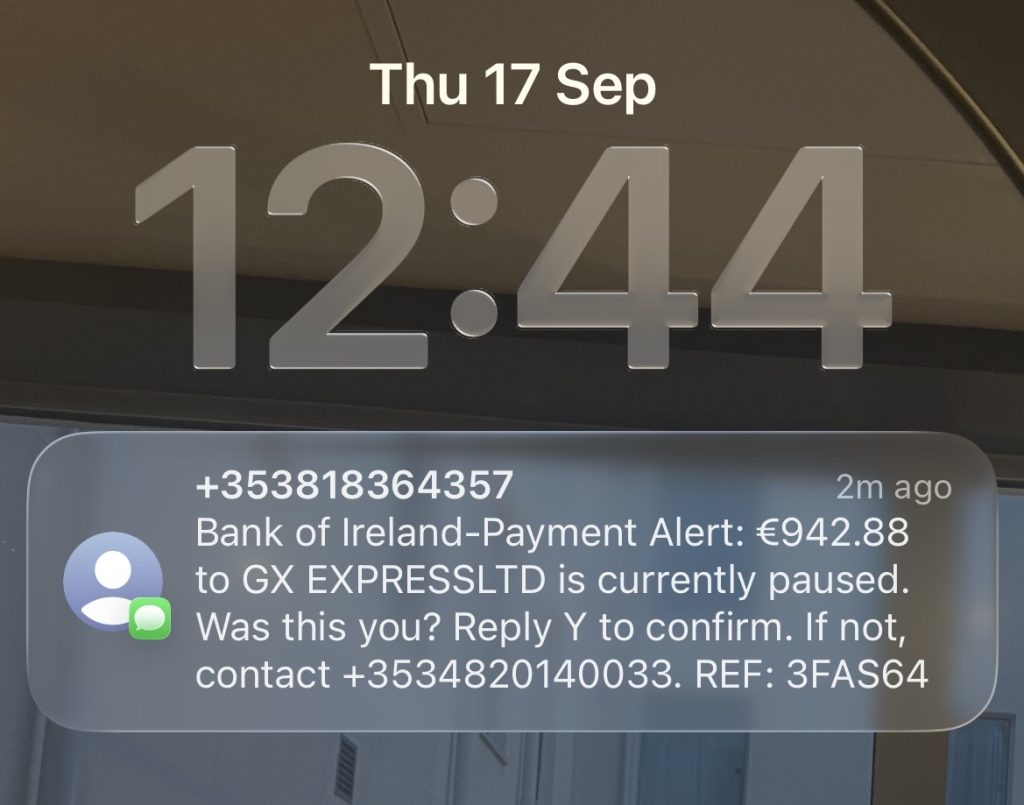
A screenshot of a scam text received recently by a Waterford person who is not a Bank of Ireland customer.
ADVICE FROM GARDAÍ
Supt. Hegarty spoke to this newspaper after the meeting to expand further on his advice for how people can remain vigilant about frauds.
“In terms of advice, there’s a couple of very simple things. Any text or email that somebody gets from anybody, purporting to be from a financial institution, or an offer, or somebody contacting them, that puts them under pressure to make a financial decision really quickly, and to click on a link, or to open up and provide details that they wouldn’t normally give away, should be avoided,” the Superintendent told The Munster Express.
He emphasised that a number of online frauds and scams can take the form of a message stating that a payment has been requested, and the recipient needs to make contact immediately.
“Anything that places pressure on people or anything that asks someone to click on a link, text message or an email should be avoided. They shouldn’t do it. They should make contact with their own financial institution, and clarify with them, not by the numbers provided on the email, but by going by the numbers on the bank’s own website,” Supt. Hegarty pointed out.
“The people in the banks and the fraud teams in the banks will have people there to clarify whether or not a payment has been requested,” Supt Hegarty added.
The Superintendent highlighted that a simple thing people can do is to check their online banking accounts daily, which will help with noticing any untoward transactions.
He said: “Look at what’s going on in your own account, so that you can see very quickly if something untoward has happened, then contact your bank. Have a quick look every day, what has happened in my bank, is there something that is unexpected?
“I do that regularly, and I have on occasion noticed stuff unexpected, but when I inquire into it, it’s because the trader’s name was different from what I expected or I did order something from a certain location and it shows up on my card as something else. But I’d be able to see it and I’d be able to go check it very quickly.”
Supt. Hegarty added: “Our advice to people is to slow down, go directly to your financial institution, and check with them first”.
“Don’t click on links within emails, don’t download external apps at the request of somebody, don’t provide them with access. A banking or financial institution will be able to see your transactions through their own systems; they don’t need you to download anything.”
FRAUD ‘SEEMS TO BE GETTING WORSE’
Independent Councillor David Daniels shared at the WLCSP meeting that his elderly relative was recently defrauded out of £25,000 sterling after falling victim to a scam over the phone. Cllr. Daniels questioned what can be done to stop criminals committing these types of fraud offences.
Cllr. Daniels said: “Can you see any way of catching these criminals? They just seem to be getting more intelligent, using more technology”.
“It’s just that we worry because if you look at a vulnerable person, they can lock their doors, but these fraudsters, they can ring them in their homes. It was only last week that my elderly cousin in England got defrauded out of £25,000.
“It was one of those things that we’ve all got, about parcels, that you need to pay money for a parcel, and they rang back and gave their bank details. They were unlucky, because they had put money into their account because they were trying to help their daughter buy a house, and they [the fraudsters] got it, the £25,000, and cleared it,” he added.
Speaking to The Munster Express following the WLCSP meeting, Cllr Daniels said: “My relative, he got one of those fraudulent texts from An Post to collect a parcel, and particularly that he’s away and he has relations in another country, so it was coming up to his birthday time and he was thinking that they were after sending something abroad for him. He tapped on to the link, and the fraudsters got his information. He was done out of large sums of money.”
Cllr. Daniels highlighted that fraud is a serious issue that seems to be getting worse, with the most vulnerable in society being caught by it.
“This is a serious issue at the moment with online technology, the issue seems to be getting worse, I know the Gardaí are doing their best to try to sort out the issue and get the culprits but it’s just getting more common now, more and more people are being caught, and I think it’s going into the millions, the money that’s actually being defrauded each year,” he told this newspaper.
Cllr. Daniels spoke of receiving a scam call himself, in which his name was used. He said: “With the development of AI, they’re taking off people’s voices and I got a phone call myself last night, I thought it was very suspicious, I got a message into my inbox and when I listened to it, it was somebody calling my name, and I know it was very fraudulent because my phone didn’t ring, it went straight into my inbox, and they called my name, and they were trying to get me to return a call, and then [once you get on a call] they will try and swindle you out of your money”.
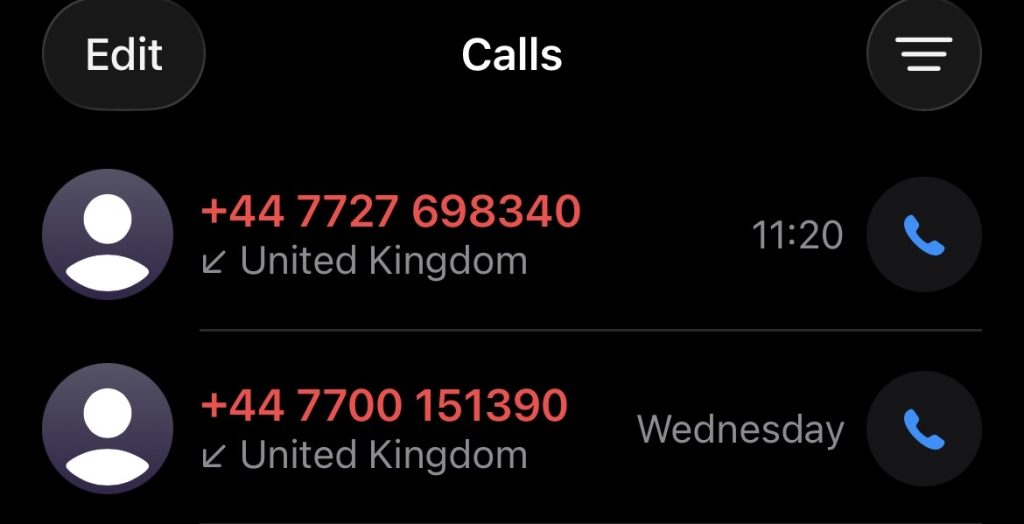
A photo of two missed calls received by a Waterford person recently that were unanswered due to the potential of scams.
SUCCESS IN FRAUD DETECTION
At the WLCSP meeting, Supt Hegarty explained that with an ongoing operation among Waterford Gardaí, there has been “fantastic success” in relation to the detection of frauds. He mentioned a recent recovery of over €2m worth of Bitcoin, which was an operation conducted with police colleagues across Europe.
He said: “Without getting into specifics, we recovered in excess of two million euros in Bitcoin as a result of an investigation we were conducting, and I think eight or nine people are currently before the courts in relation to money laundering and that type of offence. That’s a pan-European operation … and it is significant”.
FRAUD IS EASILY CATCHING PEOPLE
“Unfortunately, with the advent of AI, with the advent of technology, people are getting caught very easily with frauds. But again, we emphasise this advice over and over again. Your bank will never look for your pin numbers, your bank will never look for you to click on a link,” he said.
“If somebody’s putting you under pressure, and needs you to act now, they’re doing that for a reason. They’re trying to create a sense of panic, so that you make a decision that you wouldn’t ordinarily make. The best thing, however, that we could advise people to do is to report it to us as soon as possible. If you have any doubt, pick up the phone, call the bank yourself and speak directly to them, it can happen to us all,” Supt. Hegarty told the meeting.
The Superintendent shared that he recently became the victim of a fraud scam, when his credit card was cloned.
“It happened to me, I was defrauded of €2,500 two months ago, I got it back relatively quickly, and I’m looking at my bank account constantly,” Supt. Hegarty told the WLCSP meeting.
“The moment I saw it going out, I made contact with my bank, got everything stopped, and got them moving on it straight away. I look at my bank account every single day to make sure that nothing untoward is happening with my own accounts.
“But what I would say to you is that An Post won’t send you a message saying ‘click on the link’, DHL won’t send you a message, those links are fraudulent. People should never click on a link they’re not expecting,” he said.
Supt. Hegarty provided the example of receiving a text that appeared to be from his electricity provider, stating that they would call him the following day.
“To give you a very good example, with my electricity bills, my contract is coming up, and my provider texted me on Monday to tell me that they would be ringing me on Tuesday, and a number rang my phone. I ring them when I need to talk to them, that’s the way I would be sure it’s them, not some random person texting me,” the Supt. told the meeting.
He continued: “But if they were randomly texting me, they’re bang on, as my electricity contract is coming up for renewal, but I won’t take the chance”.
“That’s the advice we can give to people. In the [Waterford/Kilkenny] Division, if anyone wants it, [Sergeant] Deirdre [O’Neill] does go around giving crime prevention talks and crime prevention advice to people on this,” he said.
“We have gone around to retired associations, GAA clubs, schools, wherever. We’re there to give advice but also to meet people, so if anyone wants us to come anywhere to any meeting they’re having, we’ll pop in for 10 minutes and talk about it.”
9% INCREASE IN REPORTED FRAUDS
Following the meeting, The Munster Express examined figures from the Central Statistics Office (CSO) which showed that in the first three months of 2026, a total of 101 fraud, deception, and related offences were reported to Gardaí in the Waterford/Kilkenny Division.
The figures also showed an increase in the overall number of these offences reported to Gardaí over the past two years, with 473 occurring in 2024, and 515 in 2025. This is equivalent to an increase of almost 9%.
According to figures from the CSO, in the first three months of 2025, there were 124 fraud-related offences reported, which decreased to 109 in Q2, increased to 158 through July, August, and September 2025, and fell again to 124 offences reported in Q4.
In 2024, a total of 473 fraud-related offences were reported to Gardaí in Waterford and Kilkenny throughout the year. In Q1, the figures show that 126 of these offences were noted. This fell to 100 in April, May, and June 2024, and increased again to 120 being reported in Q3. In the final three months of 2024, 127 fraud-related incidents were reported to Gardaí in the Waterford / Kilkenny Division.
The CSO figures show that in 2023, the figures appear to be larger, with 152 fraud offences reported to Waterford and Kilkenny Gardaí in the final three months of the year, and 154 reported in Q3 of 2023, which is the furthest back that this data is available.
In a further examination of the figures, it shows that within the divisional figure of 515 of these offences reported in the Waterford / Kilkenny division in 2025, 293 were reported to Garda stations across Waterford, and 222 were reported to stations in Kilkenny.
REVOLUT USERS HAVE DATA LEAKED
The WLCSP meeting’s discussion of fraud and online scams comes as it was reported recently that a number of users of the banking app Revolut throughout the world had their personal data leaked.
It was reported that Revolut, which has around 3.4 million users in Ireland, informed customers that personal data such as their date of births, addresses, phone numbers, email addresses, copies of passports and driving licences were released during a data breach.
The company said that the affected customers have since been contacted, and it is believed that the data of 12 people in Ireland was subject to the breach.
A spokesperson for Revolut said the company “recently identified a sophisticated external impersonation scam where an unauthorised third party utilised a legitimate Government agency domain email to submit fraudulent requests for information.”
“Upon detection, we immediately blocked the address and alerted the relevant Government agency as well as enforcement agencies, data protection, and financial regulators. Revolut systems and customer funds are unaffected. We have contacted the limited number of impacted individuals directly to inform them and provide support,” the spokesperson added.
Funded by the Court Reporting Scheme

Robyn Power
