

Residents living in the Kilmeaden area are fearful that their village will become industrialised if a proposed data centre development gets the go-ahead.
Crag Rathnew DC Limited and Kent Homes Limited are planning a large scale development at the former cheese factory in Kilmeaden for a mixed use village centre, technology park, and renewable energy development on a total site area of 108.79 hectares, which will also include a state-of-the-art data centre.
Residents have spoken to The Munster Express about their growing concerns that the area will be industrialised if the proposed data centre development gets the go-ahead, as there are also multiple applications in the area for solar farms and battery energy storage systems.
Last Monday, 28 September, was the end of the latest submission period for the major Kilmeaden Data Centre development.
The planning file received a total of 484 submissions. Many of these come from residents and local politicians protesting against the development.
At 1.00pm on Monday, a large crowd gathered outside Waterford City and County Council’s Planning Office, located in the Menapia Building on the Mall.

Kilmeaden residents holding a protest outside Waterford Council’s planning department in Waterford City last week.
Some protesters attended with gas masks and protective suits, there was a speaker playing the droning noise of a data centre into the street, and cars honked in support.
There was a strong Sinn Fein contingent to support the protestors with TD’s, Conor McGuinness and David Cullinane in attendance, along with councillors Catherine Burke and Joeanne Bailey.
The proposed multi-billion euro development includes 16 gas turbines, 48 apartments, a supermarket, a gym, a café, a health centre, a pharmacy and more.
One of the most frequent complaints is that this development will be spread across prime agricultural land which is being actively farmed at present, at a time of rising food prices and uncertainty in the global food chain.
“At what point does your country stop being a democracy?” asked Amanda Power, who spoke to The Munster Express at the protest. “I think it’s a question of whether the government and our local councils are willing to actually listen to the people in the area of whether they are just going to hand the land and the resources of this country over to big tech, big billionaires to profit off.
AN INDUSTRIAL SHADOW
Kilmeaden resident Jane O’Brien, also spoke to this newspaper during the protest. “If you have to have it [data centre] – put it into an industrial area,” suggested Ms O’Brien.
“We’ve grown up on that road all our lives. Our grandparents, our parents, they are elderly people in their 80’s and their houses are smack bang in the middle of this. That’s not fair to those people who have worked all their lives and paid those mortgages for those houses to raise their families there. To ask them to live out their last days under the shadow of that noise and that pollution,” she said.
“Data centres research is relatively new, but the proof is start to come out. The Maynooth report that Lynn Boylan commissioned shows that there is absolutely no benefit to communities, the water number was wrong, they are way above it. We can’t handle the power, we can’t handle the water.
“The data centres in this country take 23% of our electricity grid, they employ less than 0.1% of our workforce. It was 1,500 times more intensive to have a data centre worker than a health care worker or a social care job and 700 times more labour intensive that a teaching or construction job. It just doesn’t add up.”
Waterford Council is due to make a decision on the Kilmeaden development by 19 October, next.
INFORMATION MEETING
An information Meeting was held at the Sweep Bar, Kilmeaden last Wednesday evening, where the residents’ concern group Kilmeaden Against Industrialisation handed out submission forms for people to fill in and submit.
Jane O’Brien, who is also a member of the residents’ concern group Kilmeaden Against Industrialisation said it was a busy meeting and there was a great attendance from local residents as well as from people living further afield.
She said there were at least 30 new people who filled in the submission forms to submit to the further information planning file, who didn’t make a submission originally.
“That was 30 new people – a good number of people that had never submitted originally, and are paying the money to submit this time around, which is great to see as well, so it means more people objecting,” she said.
Jane noted that in the further information supplied by the developer on the planning file, there were changes to the cooling system
“It is a hot topic at the moment, people are really aware of the water usage, so I suppose they were probably aiming to fix that issue, or the optics of that issue, and they’ve changed it to a closed loop system, which actually means that they’ll be still using water not as much, but they will be using glycol, which in itself is toxic, and that system is actually flushed then, so it raises questions as to where does that glycol go and how do they dispose of that?” said Jane, speaking to The Munster Express.
“They’ve made that sound very good, that they’re not using as much water, but what that means is they’ve had to change the gas turbines to an open system. That means they’re going to be producing much more emissions, and nitrous oxide, and other fuels coming out of those chimney flues. It’s still really bad for the environment either way.”
She noted that the further information request resulted in a huge volume of additional files and it was not obvious what changes were made in the further information documents.
“It’s really hard to find anything, it’s not very obvious what changes they’ve made, or what we’ve done, you really have to go through the files, and spend loads of time doing it. None of us are experts, so it’s really the manpower of everyone taking a bit of time, and effort to try and find the little pieces, and what we can put together.”
Jane said the residents’ group are planning more demonstrations and protest walks in the coming days and weeks to highlight their concerns.
She also drew attention to other planning applications that are going in for the Kilmeaden area. There are multiple applications around the High Road area for solar farms.
“We’re not against solar as a whole if it was going onto the grid and it was going to be used for everyone who’s struggling to pay their electricity,” said Jane. “We don’t know for certain, but the data centre needing 80% renewables for their power and the fact that the 43,000 solar panels that they are putting on the site in Kilmeaden will only give 2% of the power for what the data centre needs is pittance, it’s nowhere near enough.”
Jane said there are fears that the solar farms being sought around the Kilmeaden area could potentially be used to power the data centre.
There is already a phase 1 of the Cullenagh Solar Farm proposed for the townlands of Lahardan Glenhouse Kilmoyemoge East , Kilmoyemoge West Ballycahane , Hacketstown, which has been appealed to An Coimisiún Pleanála (Pleanála reference: PL93.500551).
Cullenagh Solar Farm has a second planning application lodged for a solar farm in the townlands of Kilmoyemoge West, Kilmoyemoge East, Lahardan, Kildermody and Glenhouse. (Council ref: 2660701), while approval has been given for development of an 800 MWh Battery Energy Storage Systems facility in the townlands of Glenhouse and Lahardan. (Council ref: 2460163).
Jane described the battery storage facility as ‘quite unusual’, “because nobody knew about this, really nobody noticed this one, and it already was kind of granted permission before anyone really knew about it”.
“And it’s isolated on its own. So, it kind of poses the question as to what’s that going to be hooked up to.
“It looks as if these are going to be aimed towards feeding into this data centre. So, our concern is that the whole of Kilmeaden is going to be industrialised, it’s going to turn into one big solar farm, all for the purpose of this data centre,” said Jane.
“It’s really taken away from the rural village that people come to Kilmeaden to live in or have lived in all their lives.
“There’s a fight and the fight is still going on, and we just seem to think they’re all relative to the one thing, which is scary. It just seems to be taking the whole village and it starts spreading out like that, the data centre on its own, and that planning and that development is terrifying, and it’s really not befitting a rural village at all.
“It just seems to be one big development – we can’t confirm that, but you have to wonder,” she added.
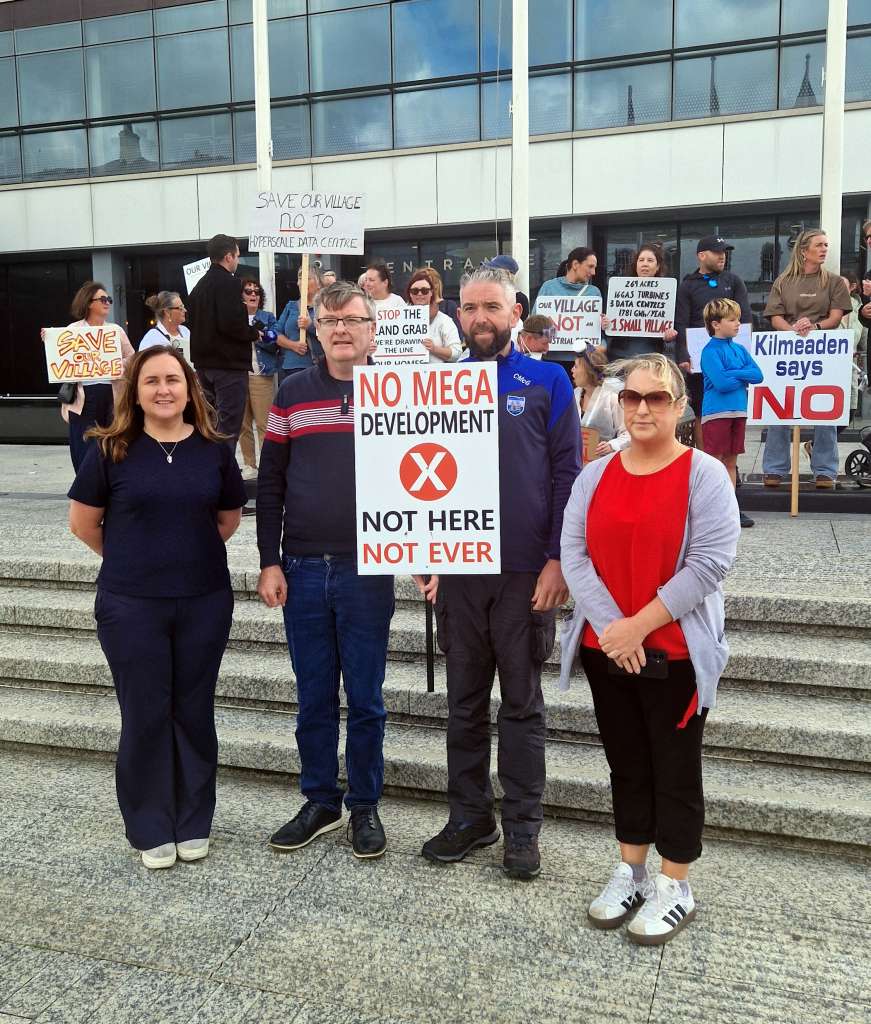
Cllr. Catherine Burke, Deputy David Cullinane, Deputy Conor McGuinness and Cllr. Joeanne Bailey attended the protest last week.
SERIOUS QUESTIONS
Sinn Féin TD for Waterford Conor D. McGuinness has said the scale and nature of the proposed Kilmeaden data centre would have a profound impact on the rural community and that the development, as currently proposed, should not proceed.
The Sinn Féin rural affairs spokesperson made the comments as part of his submission in respect of the proposed development at Blackknock and Adamstown. The development would combine a major data-centre and technology operation with substantial energy infrastructure, including gas-fired generation, battery storage, solar generation and associated electricity infrastructure.
Deputy McGuinness said: “This is an exceptionally large development for a rural community, and its scale alone raises serious planning questions.
“The proposed development would have an average electricity demand of approximately 203 megawatts, with annual electricity consumption of around 1,781 GWh.
“That is an enormous additional demand, and it has to be considered in the context of the wider pressure on our electricity system and the rapid growth in electricity demand from data centres.
“There are also serious questions around the proposed gas-fired generation, including how it would operate, its emissions and the implications for local air quality.
“Noise also needs careful consideration, particularly given the scale of the mechanical and electrical plant involved and the potential for continuous, low-frequency and tonal noise.
“I have also raised questions about the renewable-energy arrangements associated with the proposal. We need clarity on whether the renewable generation being relied upon is genuinely additional and what additional benefit it provides to the electricity system.
“This is not an argument against economic development or digital infrastructure. Data centres play a role in Ireland’s digital infrastructure and economy.
“But developments of this scale need to be properly assessed in the context of our energy system, our climate obligations, infrastructure capacity and the interests of the local community.
“The Government has itself recognised the need for a more strategic, plan-led approach to very large energy users.
“That wider context is directly relevant here. We need to look at the totality of what is being proposed and ask whether its impacts have been adequately addressed.
“Having considered the application, the further information submitted by the applicant and the issues raised by the local community, I do not believe that has been demonstrated.
“I am therefore calling on Waterford City and County Council to refuse this planning application,” Deputy McGuinness added.
Meanwhile, Sinn Féin TD for Waterford David Cullinane has said that the concerns being raised by residents in Kilmeaden about the proposed major data centre development must be fully heard and examined by Waterford City and County Council.
Deputy Cullinane attended the residents’ protest outside City Hall alongside Deputy Conor D. McGuinness and Councillors Catherine Burke and Joeanne Bailey.
The protest took place as residents continued to raise concerns about the scale of the development proposed for the former Kilmeaden Cheese Factory site. The application includes three large data-centre buildings, an energy centre with 16 gas turbines, a substantial solar farm, battery storage and other associated development.
“Residents in Kilmeaden have been raising genuine concerns about this proposal for some time, and it was important to stand with them outside City Hall and hear directly what they have to say,” Deputy David Cullinane said.
“This is a development on a very significant scale. People are raising concerns about the impact on the village, traffic, noise, the environment and the demands that a development of this size could place on energy and other infrastructure.
“Those concerns have to be taken seriously and fully examined through the planning process. The Council has an important responsibility to engage with the community and properly assess the issues residents are putting forward.
“There is also a much wider national debate about data centres. Sinn Féin has raised concerns about pressure on the electricity grid and the need to ensure that scarce grid capacity does not come at the expense of housing, transport and other essential infrastructure.
“Our Climate and Energy spokesperson P.A. Daly has introduced legislation proposing a Grid Prioritisation Framework which would allow essential public infrastructure, including housing and transport, to be prioritised when grid capacity is limited.
“The people of Kilmeaden deserve proper engagement, transparency and a planning process that fully considers the scale and potential impact of what is being proposed.
“I was glad to join Deputy Conor D. McGuinness, Councillors Catherine Burke and Joeanne Bailey, and most importantly the residents themselves, in making sure those concerns are heard,” Deputy Cullinane added.
PAUL MOONEY & AARON KENT
