
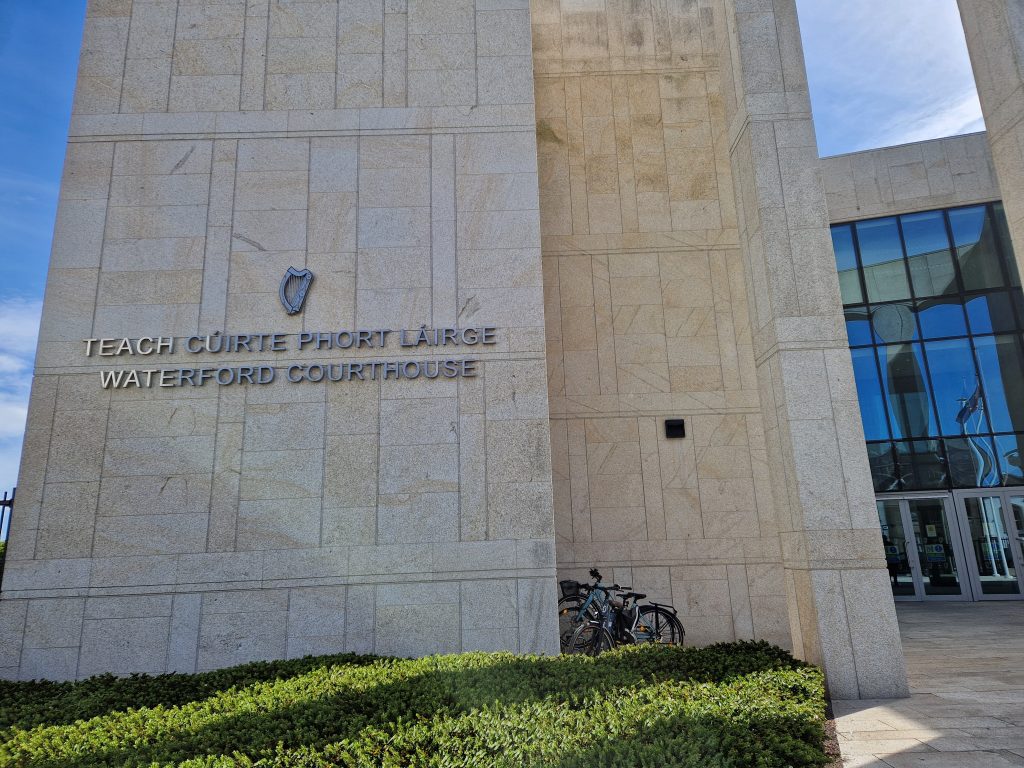
The trial of a man charged with the murder of his partner continued at Waterford Central Criminal Court last week.
Marcus O’Neill (35) of 15 O’Brien Street, Waterford city, is charged with the murder of 47-year-old Tramore woman Gillian Curran on 25 January 2025 at his home, after she was found unresponsive there by emergency services. He has pleaded not guilty and denied the murder, and is currently on trial before Ms. Justice Caroline Biggs as well as a jury of seven women and five men.

The late Gillian Curran.
The accused is being represented by Roisin Lacey SC and Tom Giles Kelly BL, instructed by solicitor Derrick Connors, while Conor O’Doherty SC and Niall Storan BL are acting as prosecuting counsel on behalf of the state.
GARDA BODY-CAM FOOTAGE
Last week, the jury heard evidence from Garda Lorraine O’Dwyer and Garda Paul Gleeson, who were two of the first Gardaí at the scene that morning.
Body-worn camera footage from both officers was played to the court, with Ms. Justice Biggs commenting that it was the first time this type of footage has been used as evidence in a criminal trial in Ireland.
Garda O’Dwyer told the court that she arrived at 15 O’Brien Street at 10.20 am that morning, and spoke to paramedics. She described observing Ms. Curran lying on the couch in the living room with ‘significant’ injuries to her face and hands, and noticing that a man, identified as Mr. O’Neill, was pacing behind the couch.
The Garda said she noticed that both of Ms. Curran’s eyes were bruised and swollen and her face was ‘covered’ in both dried and fresh blood. When she asked the accused what happened, he replied that he tried to save her, but she kept “falling and falling.”
Garda O’Dwyer and Garda Gleeson then informed O’Neill they were turning on their body-worn cameras and brought him into the kitchen, where they cautioned and searched him.
The jury were first shown several clips from Garda O’Dwyer’s body-worn camera. The first clip was taken at 10.22 am in the kitchen, with the accused seen smoking while he was searched, with just a lighter found. He explained to the Gardaí that he found Ms. Curran when he came downstairs earlier that morning, and lifted her off the ground onto the couch before calling the emergency services.
The Gardaí also asked him for his phone and details about Ms. Curran, and he informed them she was in the house for a ‘few’ months, but had previously been living in a hostel for “a while.”
Garda O’Dwyer’s second body-cam clip showed her going upstairs in the house, and she could be heard saying “blood on the bedclothes”, “blood on the wall, more blood on the wall.” However, she clarified to the jury that at that stage she had noticed what she thought was blood, but could not say for sure whether it was or not. In another clip, Garda O’Dwyer was seen returning to the kitchen where Garda Gleeson had stayed with Mr. O’Neill, and she asked him to draw the pattern to unlock his phone. She could be heard telling the accused: “Your hand is a bit swollen, isn’t it? Is it sore?” and the Garda told the jury that he wrote it down in his left hand, which appeared to be his non-dominant hand.
Following this, O’Neill was brought back to Waterford Garda Station on a voluntary basis, to provide Gardaí with more information. On the way to the patrol car, Garda O’Dwyer said he looked ‘stiff’ while walking, had blood on his trousers, and informed Garda members about previous injuries to his knee and back.
Ms. Lacey asked Garda O’Dwyer if the accused appeared to be in shock or dazed while she spoke to him, and she replied: “He appeared calm and not overly upset.”
However, she also agreed that he was co-operative with Gardaí by voluntarily providing his phone and attending the Garda Station.
Garda Gleeson told the court he noticed on his arrival at the house that Ms. Curran had cuts to her chin and forehead. He spoke to Mr. O’Neill about what happened, and he said she fell a ‘number’ of times, but the Garda could not recall where he said she fell.
The Garda said after they spoke to him in the kitchen, there was some ‘confusion’ over whether he said Ms. Curran had fallen multiple times downstairs, or down ‘the’ stairs. In one of the body-camera clips, Garda Gleeson could be heard asking him: “How do you fall down the stairs three or four times?” However, Mr. O’Neill replied: “I told you she fell downstairs three or four times…, you’re not listening to me correctly. I said she fell down here.”
Garda Gleeson said he noticed a bottle of bleach and rubber gloves on the table while he stayed in the kitchen with Mr. O’Neill, with the accused explaining that he cleaned areas of the house before paramedics arrived as he was ‘worried’ Ms. Curran would get an infection.
The Garda said that O’Neill complained of injuries to his elbow, knee and back, and he noticed the accused appeared to have an injury to his right hand. In a clip from Garda Gleeson’s camera that was played for the jury, he told Dr. Paul Campbell that he had to pop his kneecap back into place, and it had gotten sore the night before as he tried to stop Ms. Curran falling.
Dr. Campbell said it did not look like anything serious, but noted that the accused had “a bit of swelling” on his arm. The doctor confirmed after examining O’Neill’s lower back that it also did not look serious.
In another clip from Garda Gleeson’s camera that was played for the jury, O’Neill told him he and Ms. Curran had consumed alcohol the night before, but said they had not taken any drugs. The accused said she had a “bit of history” using drugs before, but not a “bad history.”
O’Neill could then be heard reiterating his version of events from that morning, by saying that when he woke up, he noticed Ms. Curran was not in bed, and went downstairs to find her by the fireplace in the living room without any clothing on. He told Garda Gleeson he put the heating on, dressed her, called an ambulance, and cleaned up a ‘bit of’ blood that was there.
Garda Gleeson clarified to Ms. Lacey that the accused didn’t say he used bleach, but had told him that he cleaned up areas of the house.
After O’Neill was voluntarily brought to Waterford Garda Station, he was questioned and formally arrested on suspicion of assault causing harm at 12.12pm on 25 January. The accused was examined by a doctor while in custody, who advised that he be brought to hospital.
ACCUSED BROUGHT TO UHW
Detective Garda Denis O’Callaghan accompanied O’Neill to University Hospital Waterford (UHW) before 3.00pm that afternoon, alongside another Garda member. The jury were shown footage from Det Garda O’Callaghan’s body-worn camera at the hospital.
Det Garda O’Callaghan told the court that he cautioned the accused before the journey, clarifying that he remained in custody the whole time he was there. In one clip taken from a hospital examination room at 4.29pm, O’Neill told a doctor he was “trying to save [his] Mrs from falling” but ‘already had’ an injury to his leg and back.
“She got drunk and collapsed, the only thing she had was alcohol…,” O’Neill could be heard saying in the clip. He added that he “realised it was serious” the next morning when she wasn’t in bed, he went downstairs, and saw “blood coming from her head, she hit it off the ground.”
O’Neill could also be heard telling the doctor that he did not call Gardaí straight away as he “didn’t want to get false allegations of assaulting people” as he had “gotten them before.”
He was additionally heard saying that he was injured from ‘driving’ his hand through a cabinet counter after Christmas, and was ‘still recovering’ from it.
“I’m telling you the truth,” the accused told the doctor.
In another clip at 4.52pm, O’Neill was being transported back to a waiting room from the hospital’s radiology department in a wheelchair. Det Garda O’Callaghan told the court that the accused told him unprompted: “I’m after remembering something, two nights ago, I punched a wall on Newgate Street after drink, around 11 or 12 at night.”
The Detective said the accused was conveyed back to Waterford Garda Station at 7.44pm that night after he was discharged from hospital.
NEIGHBOURS GIVE EVIDENCE
Several residents of O’Brien Street also gave evidence to the court last week. One woman who lived in a neighbouring house in January 2025 said she was putting her young daughter to sleep at around 9.00pm on Friday 24 January when she heard a fight starting at 15 O’Brien Street, with two voices being “very aggressive”.
“He was telling her to shut up, she was calling him bad words,” the woman said.
She told the court that she heard ‘banging’ in the house during the fight, which stopped at around 10.30 or 11.00pm. When asked by Mr. O’Doherty if she heard arguments at the house any other time, she replied that she heard a fight there on New Years Eve 2024.
“There was a discussion until late at night, it was very loud, between a woman and a man. The man was very loud, they were both screaming and shouting,” she added.
The woman agreed with Ms. Lacey that she told Gardaí in her statement that the New Year’s Eve fight had been “bigger and more heated” than what she heard on 24 January.
A male neighbour said he went out in his garden for a cigarette at around 1.30am on 25 January and heard who he believed was Mr. O’Neill, shouting in an “aggressive manner.” He added that during his time living nearby, he ‘frequently’ heard the accused giving Ms. Curran ‘verbal abuse’ and thought nothing of what he heard that night, as it was a ‘normal occurrence’ for 15 O’Brien Street.
Another woman living nearby with her partner told the court she was in the living room of her house that night, and at around 10.00 pm or 11.00 pm, she heard “a lot” of shouting from a male voice, which appeared to be coming from the accused’s house. She added that she went to bed at around 1.00 am, and heard ‘thumping’ that sounded like someone kicking a wall.
The woman said she never interacted with the accused, but knew Ms. Curran by name. However, she was not aware of which house she lived in on the street.
She told the court of an incident where Ms. Curran knocked on her door, and tried to ‘barge’ past, claiming it was her house.
“I had to get her out and close the door. She was upset and shouting down the street,” the woman said. She added that Ms. Curran sat on her doorstep and called the accused by phone, asking him to let her in the house.
‘NEUTRAL’ FINDINGS FROM BLOOD STAIN ANALYSIS
Sandra McGrath of Forensic Science Ireland also gave evidence to the court last week. Ms. McGrath, who specialises in blood staining pattern analysis, explained that she analysed swabs taken from the scene at 15 O’Brien Street, as well as clothing worn by the accused.
The t-shirt worn by Mr. O’Neill that day was firstly shown to the jury. Ms. McGrath said that blood staining was mainly on the front of it, with a small amount on the back. A pair of the accused’s jeans were also held up, and Ms. McGrath stated that blood stains appeared to be mainly on the front legs, with a small amount appearing on the back cuffs, and a small amount around the waistband.
Ms. McGrath told the jury that she took four samples each from the blood stains on both the t-shirt and jeans, and Ms. Curran’s DNA was present on all of them. She explained this is “extremely strong evidence” that the stains were her blood.
However, she added that although her DNA was found to be present, this did not address the issue of whether the accused ‘struck’ Ms. Curran. Ms. McGrath said two scenarios where the accused either struck her or had ‘contact’ with her while she was actively bleeding were “equally likely”, and it was overall a “neutral finding.”
Ms. McGrath explained that she also analysed swabs taken from different areas of the house, by firstly examining for staining and then testing for blood. She told the jury that Ms. Curran’s DNA was found on blood staining on a bedroom wall and skirting board, as well as staining on the top of the stairs and a finger mark on a press.
When blood staining from a glass panel on the kitchen door was analysed, Mr. O’Neill’s DNA was found to be present. Ms. McGrath said that blood staining on two areas of the stairs returned a match for a mixed DNA profile, with the accused’s DNA found to be a ‘major’ contributor on one and Ms. Curran’s on the other.
She concluded by highlighting to the jury that the findings were neutral, and “just show Ms. Curran was bleeding in different areas of the house.”
The trial continues.
ROBYN POWER
Funded by the Court Reporting Scheme
